
Do You Need a Food Handler Card If You Never Touch Food?

Article Summary
Food handler card requirements depend more on what you do at work than your job title. This article explains who is considered a food handler, when a card is required by state law, local rules, or employers, and why many workers are required to get an approved one.
A food handler card shows that you’ve completed an approved course on basic food safety principles and passed an exam covering topics like hygiene, cross-contamination, and time and temperature control.
In many states and local jurisdictions, food handler cards are required for people working in retail food establishments such as restaurants, bakeries, delis, and coffee shops. Some requirements also extend to school and healthcare kitchens. Even when a card isn’t required by law, employers are often allowed to make it a condition of employment.
But what if your job puts you around food without actually handling it?
Hostesses, servers, cashiers, order clerks, and dishwashers often ask whether they really need a food handler card if they never prepare or touch food directly.
This article breaks down whether you need a food handler card if you never touch food, and why the answer often depends less on your job title and more on what you actually do during a shift.
What defines a food handler?
Whether you need a food handler card usually comes down to whether your duties meet the definition of a food handler, not your job title.
A food handler is generally defined as someone who works with unpackaged food, food equipment or utensils, or food-contact surfaces.
Using that definition, many roles in a retail food establishment qualify as food handlers, even if food preparation isn’t their primary responsibility. If food handler cards are required by law in your area, or required by your employer, anyone performing those tasks must earn one.
There are a few roles that can fall outside this definition, such as hosts, cashiers, or order clerks, when they truly have no contact with food or food-contact surfaces. However, in practice, employees in these positions are often cross-trained to help cover other roles when a kitchen is short-staffed or during busy shifts.
Dishwashers and wait staff are also considered food handlers. Dishwashers handle both dirty and clean food-contact surfaces like plates, pans, and utensils. Servers may not touch food directly, but they routinely handle plates, glassware, and silverware, all of which are considered food-contact surfaces.
If you’re currently working in a role that doesn’t involve food or food-contact surfaces, your employer or local health department may not require a food handler card right away, or at all, if there are no plans for cross-training. That said, in many workplaces it becomes less a question of if you’ll be asked to help with food-related tasks, and more a question of when, at which point a food handler card is required.
Who can require a food handler card
Whether you need a food handler card ultimately depends on who requires it: your state, your local health department, or your employer.
Some states have statewide laws that require food handlers to earn a food handler card. These include:
- California
- Hawaii
- Illinois
- New Mexico
- Ohio
- Oregon
- South Carolina
- Texas
- Utah
- Washington
- West Virginia
If you work in one of these states and your job meets the definition of a food handler, a valid food handler card is required by law.
Even if your state doesn’t have a statewide requirement, local health departments can still require food handler cards. Common examples include many counties in Arizona, New York City, Livingston County in New York, and Clark County, Nevada.
And when there is no state or local requirement at all, employers can still require a food handler card as a condition of employment. In practice, many employers do. Food safety training helps reduce the risk of foodborne illness, lowers liability, and often leads to better health inspection outcomes, all of which are visible to customers.
How to get an approved food handlers card
Whether a food handler card is required by your health department, your employer, or you’re getting one proactively to strengthen your resume, it’s important to choose a provider that’s actually approved.
Most health departments and employers only recognize food handler cards issued by providers that hold ANSI National Accreditation Board (ANAB) accreditation. ANAB accreditation verifies that the training and exam meet nationally recognized standards for food safety education.
There are a few important exceptions. Some jurisdictions only accept food handler cards from providers they have specifically reviewed and approved. Utah is a common example. Other locations require food handler cards to be issued directly by the local health department itself, such as Clark County, Nevada (Las Vegas) and New York City.
If you don’t fall into one of these limited exceptions, enrolling in an ANAB-accredited food handler course is the safest and most widely accepted option.
FoodSafePal’s food handler course is ANAB-accredited and offered completely online. Most learners finish the training and exam in about 90 minutes. If you don’t pass on your first attempt, you can retake the test at no additional cost. Once you pass, your food handler card is issued automatically in digital form, with the option to upgrade to a professionally printed copy mailed to you.
Get Your ANAB-Accredited Food Handler Card in 90 Minutes
Trusted by thousands. The fastest, most reliable way to meet your health department’s requirements.
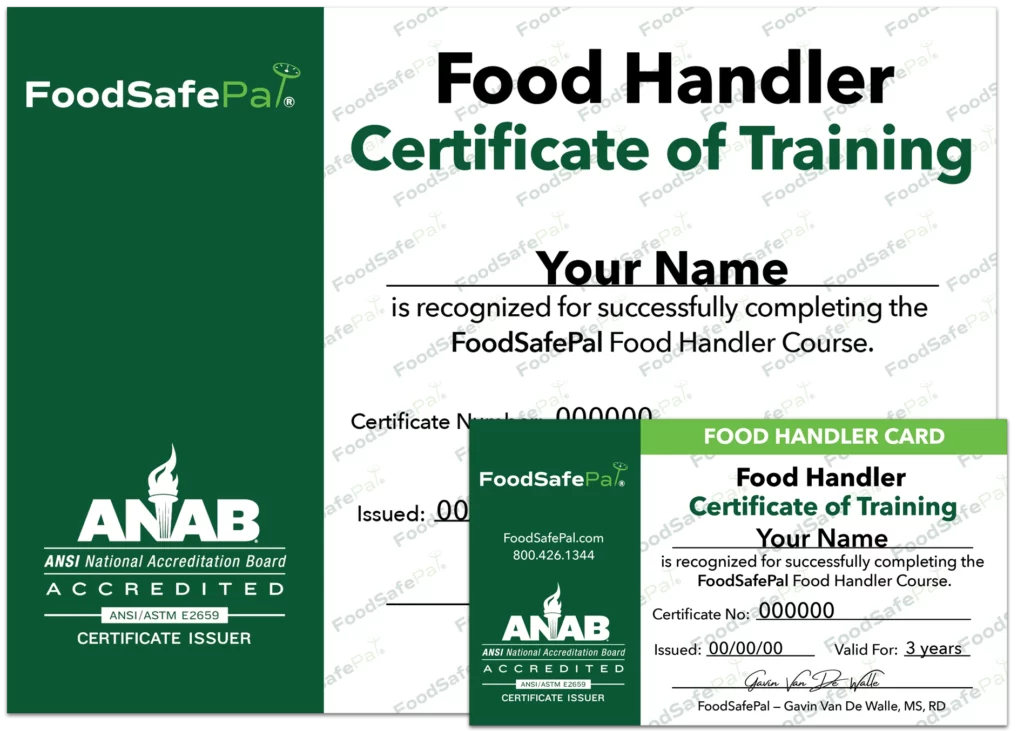
In most states, food handler cards are valid for three years. Texas is an exception, where cards expire after two years. To keep your card active, you must renew it before it expires. Renewing generally means completing an approved training course again and passing the exam, with many people choosing to renew within 30 days of expiration.
The bottom line
Needing a food handler card has less to do with your job title and more to do with what you actually do at work.
If you handle food, food equipment, utensils, or food-contact surfaces, you’re considered a food handler, and a card may be required by state law, your local health department, or your employer.
Even roles that don’t involve food at first are often cross-trained, which is why many people are required to get a card sooner rather than later.
If you need an approved, widely accepted food handler card, you can earn yours online with FoodSafePal in about 90 minutes and have your card issued immediately after you pass.
Get Your ANAB-Accredited Food Handler Card in 90 Minutes
Trusted by thousands. The fastest, most reliable way to meet your health department’s requirements.


