
Food Handler Card Requirements for Healthcare (Hospitals & Nursing Homes)

Article Summary
Food handler cards are not always required in hospital and nursing home kitchens, but many facilities and some states do require them. This article explains when a card is needed in healthcare settings, how to earn an accepted one online, and when food manager certification is required instead.
Before becoming a registered dietitian, I worked for several years as a dietary aide in nursing homes. During that time, I was required to complete regular food safety training and, in some cases, earn a food handler card as part of my job.
A food handler card shows that an individual has completed an approved food safety course and passed an exam covering core topics such as personal hygiene, cross-contamination, time and temperature control, and cleaning and sanitizing.
Food handler cards are most commonly associated with retail food establishments, including restaurants, grocery stores, bakeries, convenience stores, and coffee shops. Because of this, many healthcare workers assume the requirement does not apply to hospitals or long-term care facilities.
In reality, food handler card requirements can also apply to foodservice employees working in hospitals, nursing homes, assisted living facilities, and inpatient rehabilitation centers.
This article explains when food handler cards are required in healthcare settings, who must obtain them and how, and how requirements differ from those in traditional retail food establishments.
Who needs a food handlers card in healthcare foodservice?
The answer to who needs a food handlers card to work in a healthcare facility kitchen is not always clear-cut.
Most hospitals, nursing homes, and other long-term care facilities in the United States are regulated by the Centers for Medicare and Medicaid Services (CMS), which sets federal health and safety standards that these facilities must follow.
CMS has specific food safety requirements related to keeping food safe throughout the entire flow of food, including purchasing, receiving, storage, preparation, cooking, cooling, reheating, and service.
These requirements are enforced through routine onsite surveys conducted by licensed surveyors, typically on an annual basis and more frequently if concerns are identified. Food safety oversight is especially strict in healthcare settings because patients and residents are often more susceptible to foodborne illness due to age, underlying health conditions, or weakened immune systems.
While CMS requires foodservice employees to have food safety knowledge and demonstrate competency, it does not explicitly require dietary aides, cooks, dishwashers, or other kitchen staff to hold a food handlers card. Instead, facilities must be able to show that staff are adequately trained to prevent foodborne illness.
As a result, many hospitals and long-term care facilities require annual food safety inservice training and often rely on food handler training programs to meet these expectations, even when a food handlers card is not required by state law.
For example, in South Dakota, there is no statewide food handler card requirement, but long-term care facilities are still required to provide annual food safety training for dietary staff, and many use food handler training courses as a standardized way to document compliance.
That said, several states do explicitly require a food handlers card for individuals working in healthcare facility kitchens.
These include:
- California
- Hawaii
- Illinois
- New Mexico
- Ohio
- Oregon
- South Carolina
- Texas
- Utah
- Washington
- West Virginia
In other states, a food handlers card may not be required at the state level but may still be required by county or local health departments. Arizona is one example where local requirements may apply even in the absence of a statewide law.
How to earn an approved food handlers card online
Whether your state law or your employer requires it, earning a food handlers card can usually be done online.
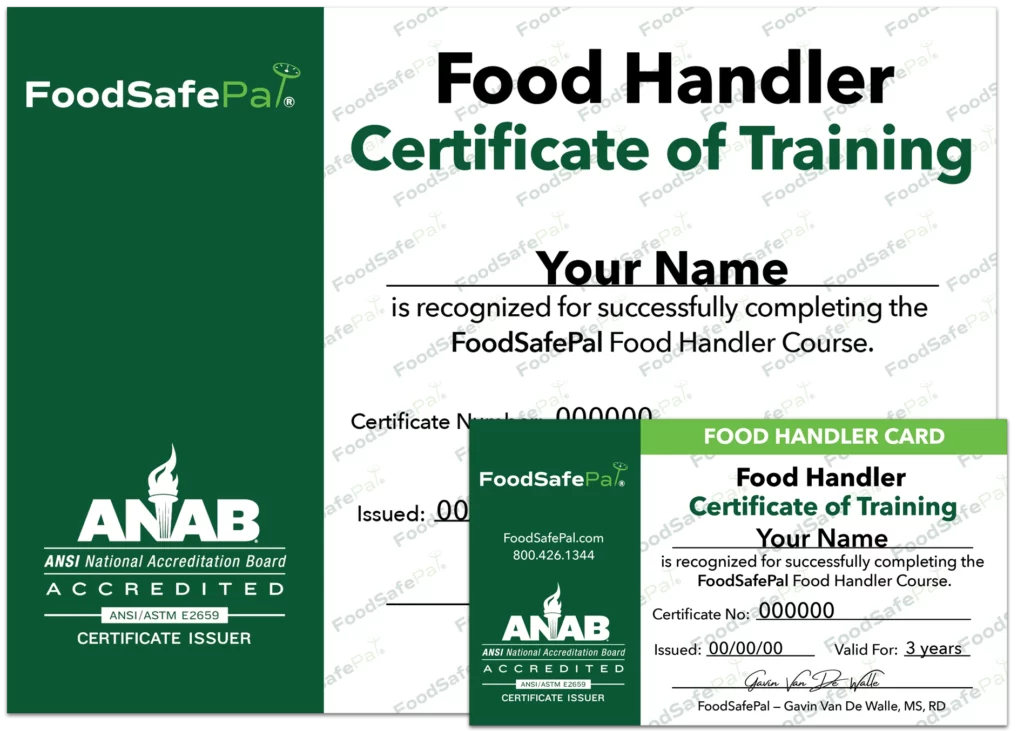
Before enrolling, it’s important to confirm that the card will be accepted by your state or employer. Food handler cards issued through courses accredited by the ANSI–National Accreditation Board (ANAB) are considered the gold standard and are accepted in most jurisdictions and healthcare settings.
An ANAB-accredited food handlers card will display the ANAB logo on both the card and the certificate. FoodSafePal’s food handler card is ANAB accredited and is accepted and recognized by healthcare facilities nationwide.
FoodSafePal’s food handler course is fully online and can be completed from any device. Most learners complete the training and test in about 90 minutes. The exam consists of 40 multiple-choice questions, and if you do not pass on the first attempt, you can retake the course at no additional cost.
Once completed, the food handlers card is valid for three years in most states, or two years if you live in Texas. However, some states, such as South Dakota, may still require proof of annual food safety training, even when the card itself remains valid.
In those cases, FoodSafePal allows you to retake the training each year during the card’s valid period without repurchasing the course. A new certificate is issued each time, making it easier to document annual training completion when required by your employer or facility.
Earn Your Healthcare Food Handler Card in 90 Minutes
Trusted by thousands. The fastest, most reliable way to meet your health department’s requirements.
When do you need food manager certification?
A food handlers card is generally designed for frontline kitchen staff, not management. However, there are times when you might need more advanced food safety training, which is where food manager certification comes in.
Every healthcare facility must have someone designated as the director of food and nutrition services. This person is responsible for overseeing the kitchen and making sure food safety requirements are followed.
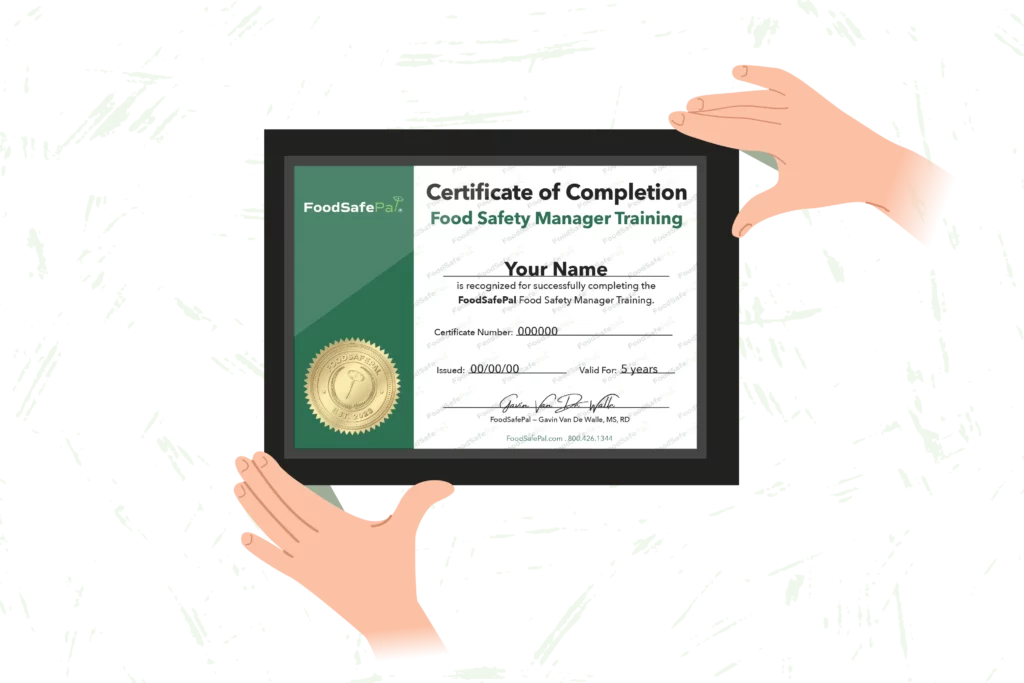
If the director is a registered dietitian, no additional food manager credential is usually needed. If the director is not a registered dietitian, the role can be met by earning food manager certification by passing the Certified Food Protection Manager (CFPM) exam.
There are no education or experience requirements to take the food manager exam. Still, completing a solid food manager training course, such as FoodSafePal’s, is strongly recommended. Unlike other food manger trainings, FoodSafePal’s food manager training is the only course that provides a full length mock exam that lets you know which questions you got right or wrong so you know what to review.
Many states require the Certified Dietary Manager (CDM) credential for the director roles in foodservice. Even in those cases, food manager certification is often still required or preferred, since it holds national accreditation.
Food Manager Certification (CFPM) Prep
Your best training for preparing to pass the food manager certification exam with ease.
The bottom line
Healthcare facilities like hospitals and nursing homes have slightly different food safety training requirements compared with traditional retail food establishments like restaurants.
To work as a dietary aid, cook, or other frontline position, your state, county, or employer may require you to earn an ANAB-accredited food handlers card, such as the one offered by FoodSafePal.
Food handler cards are generally good for three years, but you may need to complete food handler training annually if your state or employer requires it.
If you serve as the director of a healthcare kitchen, you likely need food manager certification, which you can earn by passing the exam from an accredited provider. FoodSafePal provides food manager training for this certification and will offer the accredited exam soon.
Earn Your Healthcare Food Handler Card in 90 Minutes
Trusted by thousands. The fastest, most reliable way to meet your health department’s requirements.


