Food Handler Card Requirements for School Cafeterias (K-12 & Universities)

Article Summary
Food handler cards are not always required in schools, whether K-12 and universities, but may places and some states do require them. This article explains when a card is needed in school foodservice, how to earn an accepted one online, and when food manager certification is required instead.
Food handler cards are commonly associated with restaurants and other retail food establishments. As such, most people assume they do not apply to school cafeterias, whether in elementary through grade 12 (K–12) schools or at colleges and universities.
However, just like traditional restaurants, school foodservice workers prepare and serve meals every day. For this reason, school kitchen staff meet the definition of a food handler under the Food and Drug Administration (FDA) Food Code and may be required to hold a valid food handlers card.
This article explains when food handler cards are required for school foodservice staff, how to earn an approved food handlers card online, and when a food manager certification may required instead.
Who needs a food handlers card in a school cafeteria?
Even though school foodservice workers fit the definition of a food handler — which is anyone who works with unpackaged food, food equipment or utensils, or food-contact services — food handler card rules are not always straightforward.
This is because food handler card requirements vary by state and, in may cases, by local health department. Furthermore, even when a state requires food handler cards broadly for foodservice workers, school foodservice staff may be treated differently or exempted altogether.
California and Illinois are good examples. Both states require food handler cards at the state level, but only Illinois requires school foodservice workers to hold a valid food handlers card while California does not.
Currently, the following states require a food handlers card at the state level to work in school foodservice:
- Hawaii
- New Mexico
- Ohio
- Oregon
- South Carolina
- Texas
- Utah
- Washington
- West Virginia
In other states, a food handlers card may not be required at the state level but may still be required by county or local health departments. Arizona is one example where local requirements may apply even in the absence of a statewide law.
Keep in mind that even if a food handlers card isn’t required by the state or local health department, employers can — and often do — require it as a condition of employment since food handler training reduces the risk of foodborne illness, lowers liability, and can lead to better health inspection outcomes.
How to earn an approved food handlers card online
Whether a food handler card is required by state or local law, or you simply want to strengthen your food safety knowledge and improve your resume, earning one online is usually the fastest and most convenient option.
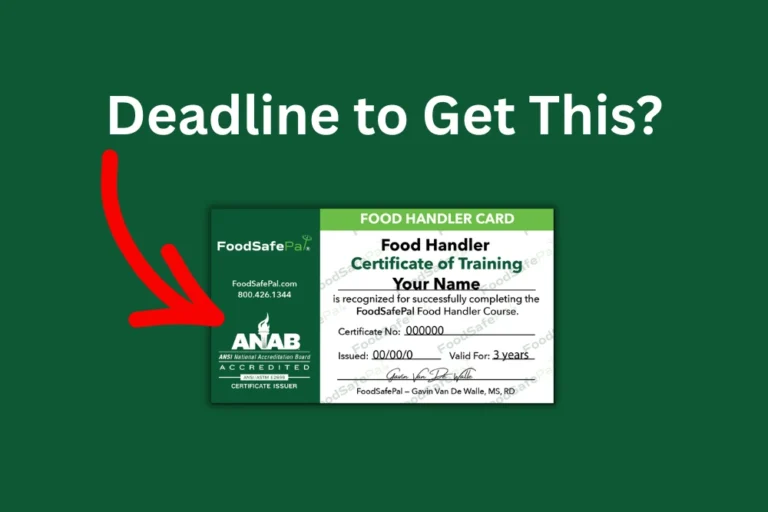
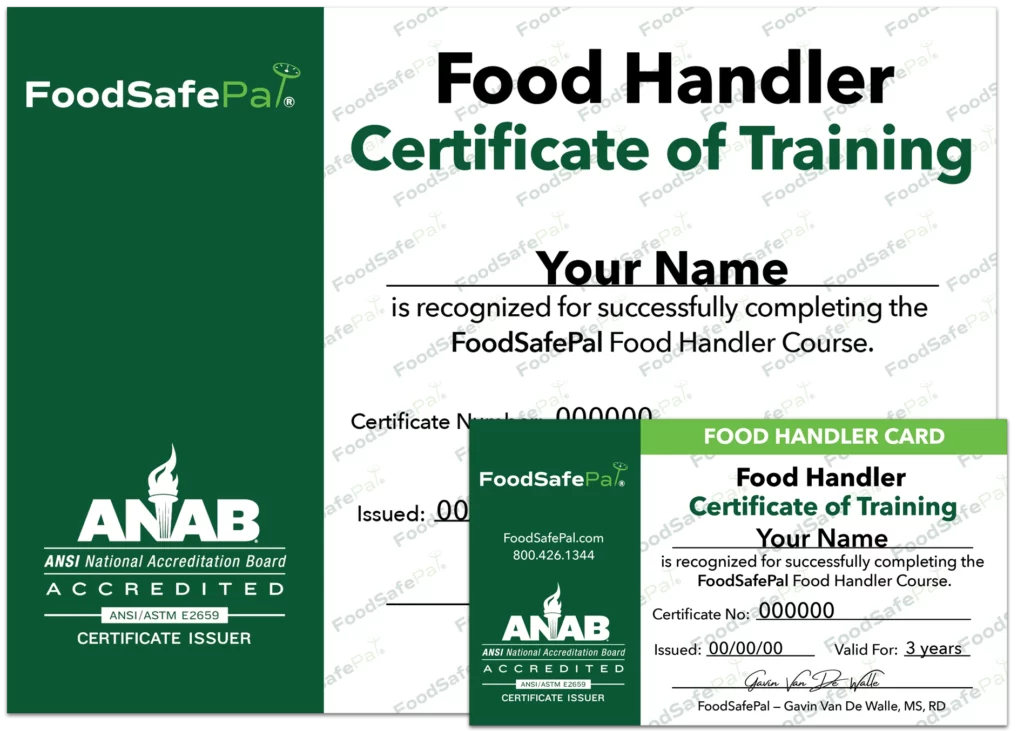
The first and most important step is choosing an approved provider. Most states and local health departments only recognize food handler cards issued by programs accredited by the ANSI National Accreditation Board (ANAB). ANAB accreditation ensures the course content and exam meet nationally recognized food safety standards. You can confirm accreditation by looking for the ANAB mark on the certificate or card, or by checking the public directory of approved issuers.
There are a few exceptions to this rule. Some states and local jurisdictions only accept food handler cards issued directly by the state or local authority. Common examples include Alaska, Washington, Clark County in Nevada, and New York City, New York. Outside of these limited cases, choosing an ANAB-accredited food handler program is the safest way to ensure your card will be valid and widely accepted.
Once you enroll in FoodSafePal’s ANAB-accredited food handler training, the entire process is completed online. Most learners finish the FoodSafePal course in about 90 minutes. The training covers essential food safety topics such as personal hygiene, cross-contamination, time and temperature control, and cleaning and sanitizing.
After completing FoodSafePal’s training, you’ll take a final exam made up of 40 multiple-choice questions based directly on the course content. If you don’t pass on your first attempt, FoodSafePal allows you to retest at no additional cost.
Once you pass the exam, FoodSafePal issues your food handler certificate and card digitally right away, allowing you to download or print them immediately. If you prefer a physical copy, you can also upgrade to receive a professionally printed card or certificate by mail.
Food handler cards are not permanent. In most states, they are valid for three years. Texas is an exception, where food handler cards are valid for two years. To keep your FoodSafePal-issued card active, you must renew it before it expires by completing another approved course and passing the exam again.
Earn Your ANAB-Accredited Food Handler Card in 90 Minutes
Trusted by thousands. The fastest, most reliable way to meet your health department’s requirements.
When do you need food manager certification?
Food handler training is designed for non-management roles that directly handle food or food-contact surfaces. This includes positions like cooks, dishwashers, servers, prep workers, and other frontline staff. The goal is to cover the basics of food safety needed for day-to-day food handling.
Food manager certification serves a different purpose. It is intended for supervisors and managers who are responsible for overseeing food safety systems and ensuring compliance. While only about a dozen states explicitly require food handler training, nearly every state requires that at least one person in charge hold food manager certification. In California, this requirement applies statewide.
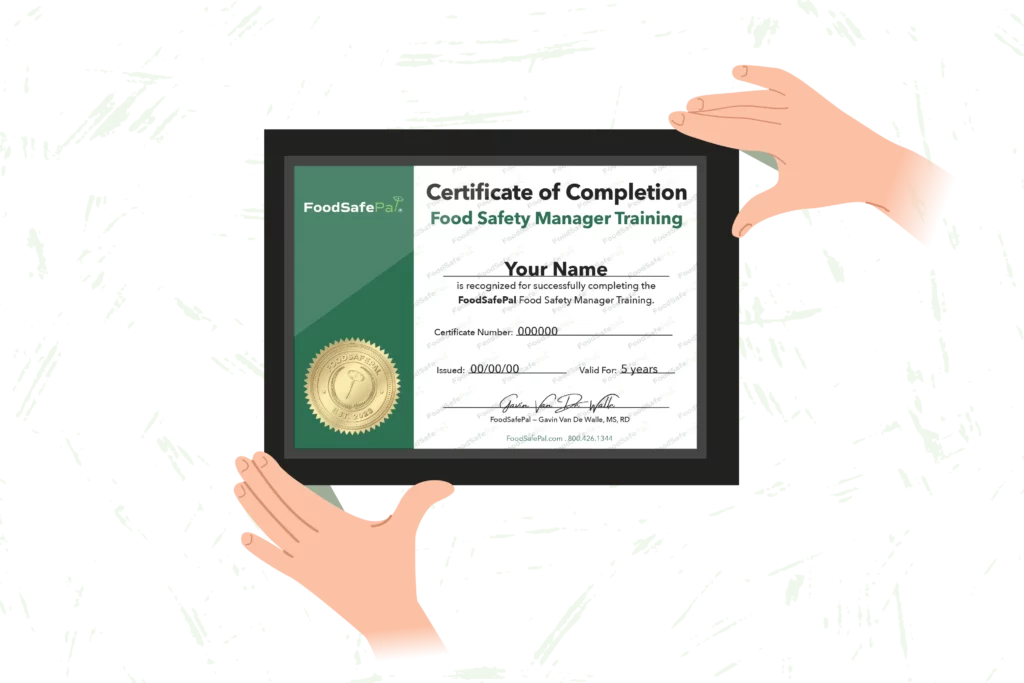
Food manager certification is formally known as Certified Food Protection Manager (CFPM). To earn it, you must pass an accredited exam. There are no minimum education or experience requirements to sit for the CFPM exam. That said, the exam is significantly more in-depth, which is why completing a structured food manager training course is strongly recommended before testing.
FoodSafePal’s food manager training is built specifically to prepare you for the CFPM exam. The course is self-paced and takes about five and a half hours to complete. You can finish it in a single day or spread it out over time, and you can always pick up where you left off.
At the end of the training, you’ll take a full-length 75-question mock exam designed to closely mirror the real test. Unlike most food manager courses, FoodSafePal shows you which questions you answered correctly and which you missed, so you know exactly what to review before exam day.
The CFPM exam itself is accredited by ANAB under the Conference for Food Protection standard. Only a limited number of organizations are authorized to offer this accredited exam, and FoodSafePal is one of them. The exam must be proctored, either online or in person.
Once earned, food manager certification is valid for five years. To renew, you must retake and pass the accredited exam.
Food Manager Certification (CFPM) Prep
Your best training for preparing to pass the food manager certification exam with ease.
The bottom line
School cafeteria staff often meet the definition of a food handler, but whether a food handler card is required depends on state, local, and employer rules.
When a card is required or recommended, earning one online through an ANSI National Accreditation Board-accredited program is usually the safest way to ensure it’s accepted, with limited exceptions where jurisdictions issue their own cards.
Food handler training applies to non-management staff, while supervisors and those in charge typically need food manager certification (CFPM), which is required in nearly every state.
Earn Your ANAB-Accredited Food Handler Card in 90 Minutes
Trusted by thousands. The fastest, most reliable way to meet your health department’s requirements.