Vermont Cottage Food Law: Do You Need Food Safety Training?

Article Summary
Selling homemade food in Vermont? The cottage food law requires state-approved training. While not a replacement for this training, earning your food handlers card can give your business an edge. This quick video explains why it’s worth it, what you’re allowed to sell, and how to get your food handler card online with FoodSafePal.
Selling homemade food can be a great way to share your products and earn extra income, but every state has its own rules you need to follow.
Each state sets its own cottage food or “homemade food” laws that define what you can make, where and how you can sell it, and whether you need food safety training.
This article explains Vermont’s cottage food law and whether you need food safety training to sell homemade food.
Vermont cottage food law
Vermont regulates home-based food businesses through a combination of licenses and licensing exemptions overseen by the Vermont Department of Health. Rather than having a single, standalone cottage food law, Vermont determines requirements based on the type of food produced, where it is made, and annual sales volume.
Certain low-risk foods may be produced in a home kitchen and sold without a food manufacturing license if you qualify for a licensing exemption.
To qualify as a cottage food operator under the exemption, you must:
- Produce or package food only in your private residential kitchen or in a kitchen on your personal property
- Sell only foods that do not require refrigeration or time or temperature control for safety
- Have gross annual receipts of $30,000 or less from the sale of cottage food products
Cottage food products are defined as non-potentially hazardous foods that are shelf-stable and safe at room temperature.
Vermont allows a variety of cottage food products, including:
- Popcorn
- Candy
- Jams and jellies
- Dry herbs
- Flavored vinegar
- Coffee beans
- Dry tea
- Trail mix, granola, cereal, and mixed nuts
- Non-potentially hazardous baked goods such as breads, cookies, muffins, and cakes that do not require refrigeration
- Home-canned pickles, vegetables, or fruits with an equilibrium pH of 4.6 or lower or a water activity value of 0.85 or less, made using recipes approved by the National Center for Home Food Preservation or reviewed by a food processing authority
If you are unsure whether a product qualifies as a cottage food, you may request a product review from the Vermont Department of Health, though approval is not required if the product clearly meets the definition.
Vermont does not allow cottage food operators to sell higher-risk foods under the exemption, including:
- Raw sprouts
- Dehydrated meats
- Eggs and egg-based foods
- Milk and dairy products
- Tofu and soy-protein foods
- Untreated garlic or herbs stored in oil
- Meat, poultry, fish, shellfish, or seafood
- Cooked plant-based foods such as rice, beans, or vegetables
- Foods that require refrigeration or time and temperature control for safety
- Dehydrated fruits or vegetables that require specialized processing
- Baked goods that must be kept cold, such as cheesecake, quiche, or cheese danish
You can sell directly to the end customer, but you cannot sell to restaurants, grocery stores, or other licensed food establishments.
If you prepare meals or other ready-to-eat foods in your home kitchen for direct sale, or prepare food for cooking later at a farmers market or special event, you do not qualify for the exemption and must obtain a Home Caterer License. Some activities may also require a Temporary Food Service License.
Summary
Vermont allows certain shelf-stable, low-risk foods to be produced and sold from a home kitchen under a licensing exemption if annual sales remain at or below $30,000. Foods requiring refrigeration, temperature control, or specialized processing are not allowed, and you cannot sell cottage food products to restaurants or retail food establishments.
Do you need food safety training to sell homemade food in Vermont?
To operate under a cottage food exemption, Vermont requires you to complete the Department of Health’s License Exempt Food Processors and Cottage Food Operators Online Training each year. This training consists of reviewing a slide-based document that explains the Manufactured Food Emergency Rule and basic food safety expectations. There is no quiz, no exam, and no assessment of whether you understood or can apply the information.
Once you reach the final slide, the training simply states that your training is complete.
In other words, Vermont’s requirement confirms that you opened and reviewed the material. It does not evaluate your food safety knowledge, test your decision-making, or verify that you can safely handle food in real-world situations. Someone could technically scroll through the slides and claim completion without demonstrating any understanding at all.
That distinction matters.
Food safety failures don’t happen because someone hasn’t seen a rule before. They happen because someone doesn’t recognize a risk, misunderstands how contamination occurs, or applies food safety principles incorrectly during day-to-day food handling.
This is where an ANSI-National Accreditation Board (ANAB)-accredited food handler course adds real value.
ANAB-accredited food handler training requires learners to complete a thorough training course and pass a knowledge-based exam. You must demonstrate that you understand key food safety concepts, including cross-contamination, allergen control, cleaning and sanitizing, personal hygiene, and which foods require time and temperature control for safety.
FoodSafePal’s Food Handler course is ANAB accredited, fully online, and takes about 90 minutes to complete. After passing the exam, you receive your Vermont food handler card and certificate that show you didn’t just review food safety information — you proved that you understand it. You can also upgrade to receive a professionally printed copy in the mail.
So, while Vermont does not require an ANAB-accredited food handler card for cottage food operators, earn one provides documented proof of competency that goes far beyond the state’s minimum requirement. Many operators choose this route to protect their customers, reduce risk, and show a higher level of professionalism to markets, event organizers, and insurance providers.
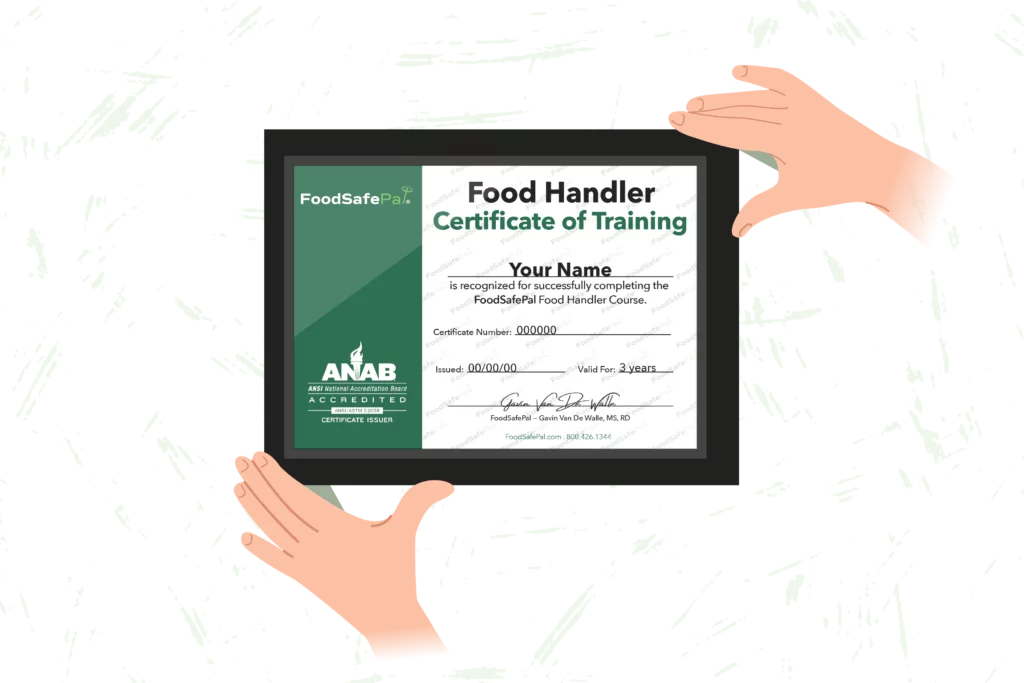
Get Your Vermont Food Handlers Card
Instant certificate. 100% online in about 90 minutes.
Summary
Vermont requires annual food safety training for cottage food operators claiming a licensing exemption, but the required training does not assess knowledge through an exam. Completing an ANAB-accredited food handler course, such as FoodSafePal’s, can provide additional assurance that you understand and can apply food safety principles.
Labeling requirements
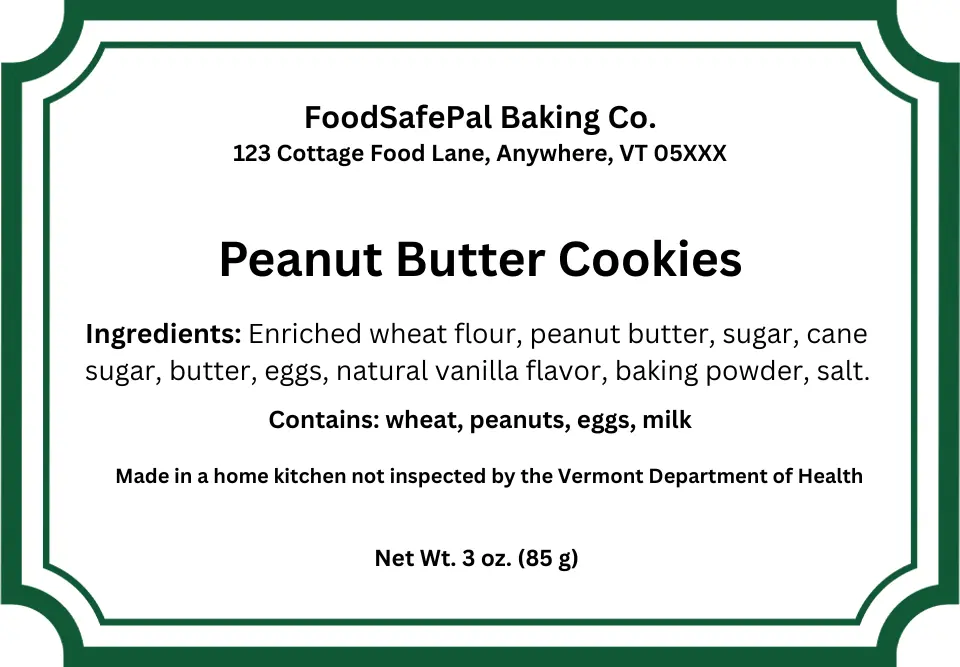
Vermont requires all packaged cottage food products to be labeled before sale. Foods sold from bulk containers do not need individual labels, but the required information must be clearly displayed on a sign or placard at the point of sale.
Each label must include:
- Your name and physical address
- Product name
- Ingredients listed in descending order by weight, including sub-ingredients
- Allergen information
- The net weight or net volume of the product
- The following statement in at least 10-point type: “Made in a home kitchen not inspected by the Vermont Department of Health.”
If you make nutrient content or health claims, such as “low sugar” or “high fiber,” you must include a complete Nutrition Facts panel and meet all federal labeling requirements. Because this adds complexity, many cottage food operators choose not to make nutrition or health claims.
You must use your physical home address on the label. A post office box cannot be used, as the address must allow regulators to locate the business in the event of a food safety concern or recall.
Summary
Vermont requires that each product you make have a label that includes you name and physical address, product name, ingredients, allergens, net weight or volume, and a home-kitchen disclosure. Nutrition labeling is required only when health or nutrient claims are made.
The bottom line
Vermont allows you to sell certain low-risk, shelf-stable homemade foods under a cottage food licensing exemption if annual sales stay at or below $30,000. Foods that require refrigeration, time and temperature control, or specialized processing are not allowed, and cottage food products may not be sold to restaurants or retail food establishments.
Vermont requires food safety training to claim this exemption, but that requirement is minimal. The state’s training consists of reviewing a slide-based document and does not include any exam or verification that you understand food safety principles. Completion confirms exposure to information, not competency.
For many cottage food operators, that gap is uncomfortable.
Earning an ANAB-accredited food handler card, such as the one offered by FoodSafePal, fills that gap by requiring you to demonstrate real understanding through a knowledge-based exam. While it is not required by Vermont law, it provides stronger protection for your customers, clearer proof of competence, and added credibility for your business as it grows.
Get Your Vermont Food Handlers Card
Instant certificate. 100% online in about 90 minutes.