Oregon Cottage Food Law: Do You Need Food Safety Training?

Article Summary
Selling homemade food in Oregon? The cottage food law requires county-approved training. This quick video explains how to get an approved card, what you’re allowed to sell, and labeling requirements.
Selling homemade food can be a great way to share your products and earn extra income, but every state has its own rules you need to follow.
Each state sets its own cottage food or “homemade food” laws that define what you can make, where and how you can sell it, and whether food safety training is required.
This article explains Oregon’s cottage food law and whether you need food safety training to sell homemade food.
Oregon cottage food law
Oregon does not have just one law that governs all homemade or home-based food sales. Instead, the state has several different legal frameworks, and which one applies depends on what you’re selling and how you plan to sell it.
Oregon has Farm Direct rules, which apply when you are selling foods that you grow yourself, such as fresh produce, honey, or certain farm-processed products. In addition, Oregon offers Domestic Kitchen licensing for home-based food businesses that want to sell higher-risk foods, exceed cottage food sales limits, or produce foods that do not qualify under the Cottage Food Exemption.
The most common framework, and the one this article focuses on, is Oregon’s Cottage Food Exemption. It applies to most home bakers and small food businesses selling shelf-stable foods from home.
Oregon’s Cottage Food Exemption allows people to make and sell certain low-risk foods from their home kitchen without obtaining a food establishment license or undergoing routine inspections by the Oregon Department of Agriculture (ODA).
To qualify, all products must be non-time/temperature controlled for safety. This means the foods must be shelf-stable, safe at room temperature, and not require refrigeration or freezing to prevent the growth of harmful bacteria.
Oregon allows a wide range of shelf-stable foods, including:
- Syrups
- Nut mixes
- Coffee beans
- Popcorn and popcorn products
- Baked goods that do not require refrigeration
- Powdered drink mixes made from commercial foods
- Confectionery items, including certain freeze-dried candies
- Honey and honey products made with commercial ingredients
- Jams and jellies made only with fruits that have a natural pH below 4.6
- Fruit butters made only from fruits with a natural pH below 4.6
- Dried tea, spice, or seasoning blends made from commercial foods
- Repackaged dried or dehydrated foods purchased from commercial sources
- Repackaged freeze-dried foods purchased from commercial sources
All products must be shelf-stable and safe to store at room temperature.
Examples of foods that are not allowed under the Cottage Food Exemption include:
- Pet treats
- Brewed or bottled tea
- Home-produced freeze-dried meals
- Meat or meat-containing products of any kind
- Cream pies, cheesecakes, and other refrigerated desserts
- Focaccia-style breads containing vegetables or cheese
- Chocolate-covered fresh fruit or candied fresh fruit
- Baked goods containing meat, poultry, seafood, or fish
- Pastries with custard, cream, meringue, or cream cheese fillings or frostings
These foods are considered higher risk and require a licensed and inspected kitchen.
Under Oregon’s Cottage Food Exemption, you may sell up to $51,200 per year in gross sales. If you exceed this limit and want to continue operating from a home kitchen, you must become licensed and inspected by ODA as a domestic kitchen.
You can sell your products directly from your home, at farmers markets, roadside stands, and community events, online and through mail orders, and to retail stores under specific conditions, as long as products are packaged, labeled, and stored separately with required signage.
You may not sell cottage foods to institutions such as restaurants, caterers, schools, daycare centers, hospitals, nursing homes, or correctional facilities.
Summary
Oregon allows a broad range of shelf-stable foods to be made and sold from a home kitchen without a license or routine inspections. Foods that require refrigeration, contain meat, or otherwise need time or temperature control for safety are not allowed. Sales are capped annually, and there are specific rules for retail and online sales.
Do you need food safety training to sell homemade food in Oregon?
Oregon requires food safety training for cottage food operators.
Everyone involved in the preparation of cottage foods under the Cottage Food Exemption must complete a food handler training program.
However, Oregon is very specific about which food handler cards it accepts.
In most cases, food handler cards must be issued by the Oregon Health Authority (OHA) or by a local public health department. Not all online or nationally accredited food handler courses are accepted for cottage food compliance in Oregon.
Because acceptance can vary by county, it’s essential to check directly with your local health department to confirm which food handler training programs they approve before enrolling.
Some nationally accredited courses, including FoodSafePal’s, may be useful for general food safety knowledge or for work in other states, but they are not accepted everywhere in Oregon for cottage food purposes. Verifying acceptance ahead of time can help you avoid unnecessary costs or delays.
Summary
Oregon requires food safety training for cottage food operators, but only certain food handler cards are accepted. Always confirm approved training with your local health department before enrolling in a course.
Labeling requirements in Oregon
Oregon has detailed labeling requirements for cottage foods. Labels must be clear, complete, and easy to read.
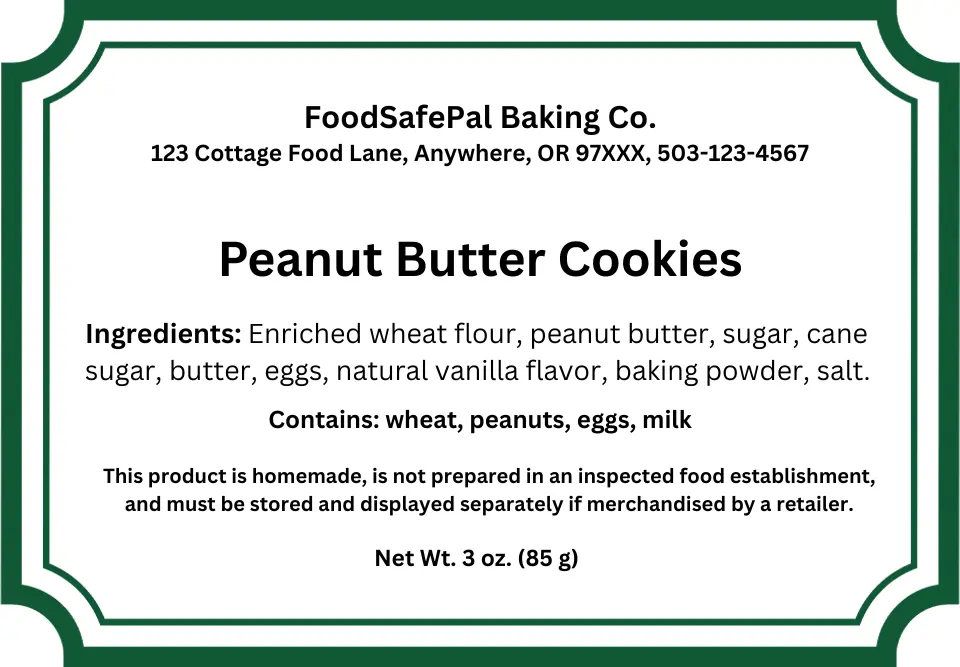
Each product label must include:
- The name of the food
- Ingredients listed in descending order by weight, including sub-ingredients
- Allergen information as required by federal law
- The business name
- A business phone number
- Either:
- Your full street address, city, state, and ZIP code
- Your city, state, and ZIP code if listed in a city directory
- Or a Unique Identification Number (UIN) issued by the Oregon Department of Agriculture
- Net weight or net volume in both U.S. and metric units
- The required statement:
“This product is homemade, is not prepared in an inspected food establishment, and must be stored and displayed separately if merchandised by a retailer.”
If pets are present in the residential dwelling, the label must also include a statement declaring that pets are present and identify the species, such as dog or cat.
Labels must be clearly visible and not obscured by logos or artwork.
If you make nutrition or health claims, such as “low sugar” or “high fiber,” you must also include a compliant Nutrition Facts panel and meet all federal labeling requirements.
For large or unpackaged items, such as wedding cakes, required labeling information may be provided on a receipt or written document given to the customer.
Summary
Every cottage food product sold in Oregon must be labeled with the required information, including ingredients, allergens, contact details or a UIN, net weight or volume, pet disclosures if applicable, and the required homemade food statement.
The bottom line
Oregon’s Cottage Food Exemption allows you to start a home-based food business selling a wide range of shelf-stable, low-risk foods without a food establishment license or routine inspections.
You must stay under the annual sales limit, sell only approved foods, follow strict labeling rules, and complete food safety training through an approved provider recognized by your local health department.
Foods that require refrigeration, contain meat, or otherwise need time or temperature control for safety are not allowed, and selling to institutions like restaurants or schools is prohibited.