Food Handlers Card vs. Food Manager Certification: What’s the Difference?

Article Summary
A food handlers card equals basic food safety for employees, while food manager certification equals advance food safety for leaders. Your role and local rules decide which one you need. This quick video breaks it all down for you.
If you work at a food establishment or anywhere food is prepared and served — such as healthcare facilities or schools — you’ll likely need some form of food safety training. This is because improper food handling is one of the leading causes of foodborne illness.
There are two main types of food safety training: food handler training and food manager certification. But how do they differ, and which one do you need for your role?
This article breaks down the key differences between a food handlers card and food manager certification, along with the steps to earn the right one for your job.

What is a food handlers card?
A food handlers card or certificate proves that you’ve completed training on basic food safety principles, including:
- good personal hygiene
- time-temperature controls for safety
- cross-contamination and cross-contact prevention
- cleaning and sanitizing procedures
Food handler training is intended for workers in non-management positions, including:
- servers, bussers, and dishwashers
- baristas, bartenders, and barbacks
- cooks and food prep workers
Many states and counties mandate food handler training, requiring workers to earn a card before or shortly after starting a job. Even in places without legal requirements, employers often make it a condition of employment.
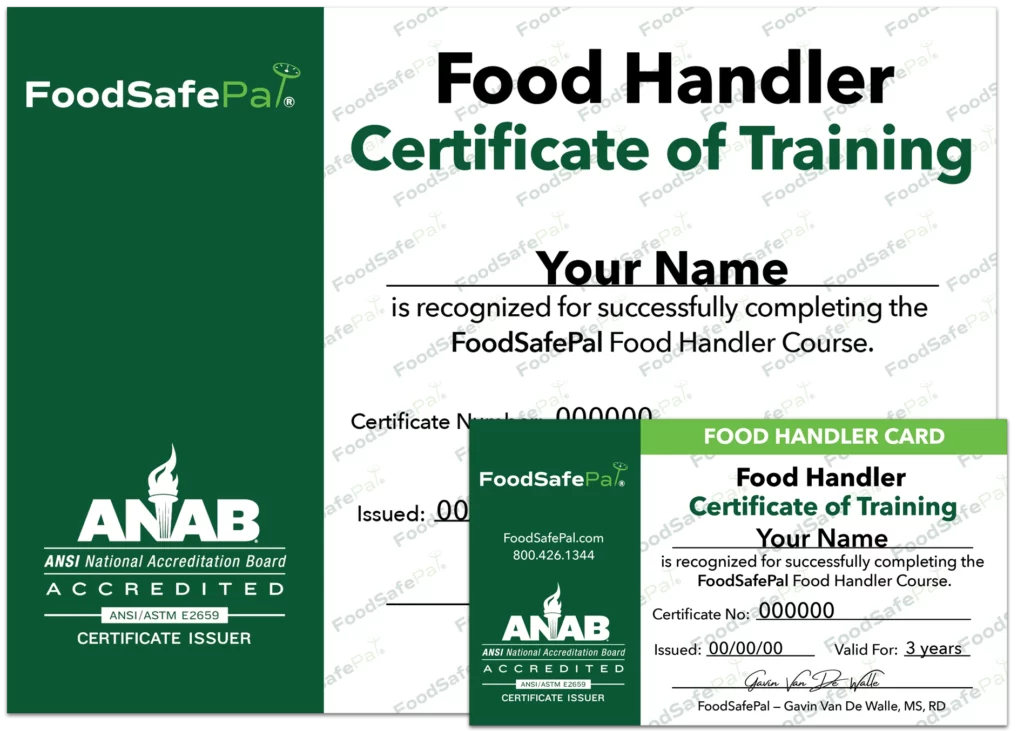
While many organizations offer food handler training, only those accredited by the ANSI–National Accreditation Board (ANAB) are widely accepted by state and local authorities. FoodSafePal’s course, for example, is ANAB-accredited and can be completed entirely online in just 90 minutes.
While many organizations offer food handler training, only those that are ANSI-National Accreditation Board (ANAB)-accredited like FoodSafePal’s are usually accepted by state and local laws or employers.
Food handlers cards are typically valid for two to three years, depending on your state. Renewing is easy — simply retake the training and test.
Earn Your ANAB-Accredited Food Handler Card in 90 Minutes
Trusted by thousands. The fastest, most reliable way to meet your health department’s requirements.
What is a food manager certification?
A food manager certification proves you’ve mastered advanced food safety topics, such as:
- active managerial control
- hazard analysis and and critical control points (HACCP)
- Food and Drug Administration (FDA) Food Code requirements
The certification is designed for management-level roles, including:
- owners, dietary managers, and chefs
- food truck operators
- person-in-charge during shifts
Nearly every state requires at least one Certified Food Protection Manager (CFPM) per shift. Only certifications accredited by the ANAB Conference for Food Protection (CFP), like FoodSafePal’s are accepted by health departments.
There are no prerequisite to taking the exam. However, preparation is key to avoid wasting time and money retaking the test, which typically consists of 60–90 multiple-choice questions.
Training is usually sold separately or bundled with the exam. For example, you can purchase FoodSafePal’s food manager training and exam alone or combined.
You must take the exam under proctored conditions, though online options allow you to test from home.
Food manager certification is good for five years from the date you pass the test and must be renewed by taking the exam.
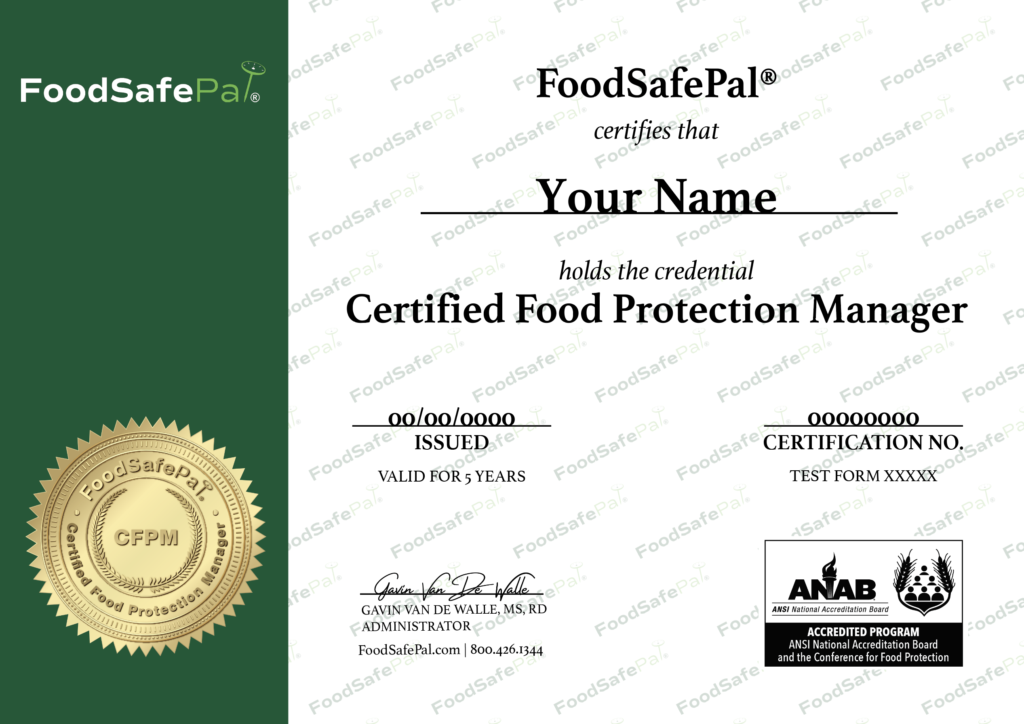
Get Your Food Manager Certification Online
Certified Food Protection Manager (CFPM) Certification. Train, test, or both — 100% online.
Food handlers card vs. food manager certification
Here’s a table comparing the food handlers card with the food manager certification:
| Food Handlers Card | Food Manager Certification | |
|---|---|---|
| What it does | Demonstrates knowledge of basic food safety principles | Demonstrates advanced food safety knowledge and compliance |
| Who it’s for | Non-management workers (e.g., servers, cooks, bartenders) | Managers, owners, chefs, and persons-in-charge |
| Topics covered | Personal hygiene, time-temperature control, cleaning and sanitizing, and cross-contamination prevention | Everything in food handler training, plus HACCP and FDA requirements |
| Cost | $10–$30 (varies by provider) | $80–$200 (varies by provider) |
| Time to complete | 1–2 hours for training and test | 7–12 hours for preparation and test |
| Valid for | 2–3 years | 5 years |
| Renewal requirements | Retake the training and test | Retake and pass the certification exam (training is recommended) |
State requirements for food safety training
Depending on where you live and work, you will likely need to earn a food handlers card or food manager certification.
Here’s a breakdown of each state’s requirements when it comes to a earning a food handlers card or food manager certification:
|
State |
Food Handler Card Required |
Certified Food Protection Manager (CFPM) Required |
|---|---|---|
|
Alabama |
No, but Jefferson and Mobile counties require it. |
Yes |
|
Alaska |
Yes |
Yes |
|
Arizona |
No, but several counties do, and your employer may require it. |
No state law, but many counties require it |
|
Arkansas |
No, but it is recommended and your employer may require it. |
Yes |
|
California |
Yes, within 30 days of employment. Riverside, San Bernardino, and San Diego counties have their own food handler card requirements. |
Yes |
|
Colorado |
No, but it is recommended and your employer may require it. |
Yes |
|
Connecticut |
No, but it is recommended and your employer may require it. |
Yes |
|
Delaware |
No, but it is recommended and your employer may require it. |
Yes |
|
Florida |
Yes |
Yes |
|
Georgia |
No, but it is recommended and your employer may require it. |
Yes |
|
Hawaii |
Yes |
Yes |
|
Idaho |
No, but it is recommended and your employer may require it. |
Yes |
|
Illinois |
Yes, within 30 days of employment. |
Yes |
|
Indiana |
No, but it is recommended and your employer may require it. |
Yes |
|
Iowa |
No, but it is recommended and your employer may require it. |
Yes |
|
Kansas |
No, but Leavenworth require it. |
Yes |
|
Kentucky |
No, but it is recommended and your employer may require it. |
Yes |
|
Louisiana |
No, but it is recommended and your employer may require it. |
Yes |
|
Maine |
No, but it is recommended and your employer may require it. |
Yes |
|
Maryland |
No, but it is recommended and your employer may require it. |
No state law, but many counties require it |
|
Massachusetts |
No, but it is recommended and your employer may require it. |
Yes |
|
Michigan |
No, but Lenawee County requires it, and your employer may require it. |
Yes |
|
Minnesota |
No, but it is recommended and your employer may require it. |
Yes |
|
Mississippi |
No, but it is recommended and your employer may require it. |
Yes |
|
Missouri |
No, but several counties require it. |
No state law, but many counties require it |
|
Montana |
No, but Sanders County requires a four-hour food safety training course. |
Yes |
|
Nebraska |
No, but Lincoln-Lancaster County requires it. |
No state law, but many counties require it |
|
Nevada |
No, but Clark County — also known as the Southern Nevada District — does. |
No state law, but many counties require it |
|
New Hampshire |
No, but it is recommended and your employer may require it. |
Yes |
|
New Jersey |
No, but it is recommended and your employer may require it. |
Yes |
|
New Mexico |
Yes, within 30 days of employment. |
Yes |
|
New York |
No, but Orleans County, Livingston County, and New York City require it. |
Yes |
|
North Carolina |
No, but it is recommended and your employer may require it. |
Yes |
|
North Dakota |
No, but several countis require it within 30 days of employment. |
No state law, but many counties require it |
|
Ohio |
Yes, person in charge certification in food protection is required. |
Yes |
|
Oklahoma |
No, but Norman, Moore, and Tulsa require it. |
No state law, but many counties require it |
|
Oregon |
Yes, within 30 days of employment. |
Yes |
|
Pennsylvania |
No, but it is recommended and your employer may require it. |
Yes |
|
Rhode Island |
No, but it is recommended and your employer may require it. |
Yes |
|
South Carolina |
Yes |
No state law, but many counties require it |
|
South Dakota |
No, but it is recommended and your employer may require it. |
Yes |
|
Tennessee |
No, but it is recommended and your employer may require it. |
Yes |
|
Texas |
Yes, within 30 days of employment |
Yes |
|
Utah |
Yes, within 30 days of employment. |
Yes |
|
Vermont |
No, but it is recommended and your employer may require it. |
Yes |
|
Virginia |
No, but it is recommended and your employer may require it. |
Yes |
|
Washington |
Yes |
Yes |
|
West Virginia |
Yes |
Yes |
|
Wisconsin |
No, but it is recommended and your employer may require it. |
Yes |
|
Wyoming |
No, but it is recommended and your employer may require it. |
No state law, but many counties require it |
Remember, even if there are no state or local requirements for a food handlers card or food manager training, your employer may still require it.
The bottom line
Food safety training is almost always required to work at a food establishment or place that prepares and serves food like a healthcare facility or school.
A food handlers card is ideal for employees, proving knowledge of basic food safety practices. In contrast, a food manager certification is for those in leadership roles, covering advanced food safety topics.
Your role and workplace requirements will determine which certification you need, but earning one can enhance your credibility and confidence in any food-related job.
You can earn either your ANAB-accredited food handlers card or food manager certification online with FoodSafePal.
Get Your Food Manager Certification Online
Certified Food Protection Manager (CFPM) Certification. Train, test, or both — 100% online.