CDM vs CFPM: What’s the Difference?

Traditional food establishments and places that prepare and serve food like healthcare facilities and schools must have at least one person in charge per shift.
This person generally must hold manager level training certification, demonstrating they know how to prevent foodborne illnesses and apply hazard analysis and critical control point (HACCP) principles.
The Certified Dietary Manager (CDM) and Certified Food Protection Manager (CFPM) are the only two widely-accepted programs by state and local health departments, but they have their differences.
This article breaks down the key differences between the CDM and CFPM certifications so you can determine which is best for you.

What is a Certified Dietary Manager (CDM)?
The Certified Dietary Manager (CDM) certification is granted to those who achieve competencies in five key areas:
- nutrition
- foodservice
- personnel and communications
- sanitation and safety
- business operations
Food safety is an essential competency area, so after earning certification, you also achieve the Certified Food Protection Professional (CFPP) credential. Together, they form the full title: CDM, CFPP.
To sit for the exam, you must meet the requirements of at least one of the following pathways:
- Pathway I: Completion of an approved foodservice manager training program with proof of completion or inclusion on the official graduate listing.
- Pathway II: A college degree in foodservice management, nutrition, culinary arts, or a related field, with at least one nutrition course and two foodservice management courses.
- Pathway III(a): Completion of a 90-hour foodservice course and two years of full-time non-commercial foodservice management experience.
- Pathway III(b): Completion of the classroom portion of an approved program and two years of full-time non-commercial foodservice management experience.
- Pathway IV: U.S. military graduates of a 90-hour foodservice training program with two years of non-commercial foodservice management experience.
- Pathway V: A college degree in another field plus five years of full-time non-commercial foodservice management experience.
The exam is three hours long and includes 160 multiple-choice questions. Of these, 140 questions are scored, while 20 are unscored pretest questions used for evaluation purposes. The exam must be completed at a designated testing center.
The exam fee is $425. This cost doesn’t include any study materials that you purchase to prepare for the exam.
To maintain the CDM credential, you must complete 45 hours of continuing education every three years. Nine of these must be in sanitation and safety and at least one hour must relate to professional ethics.
CDMs primarily work in healthcare facilities but also correctional facilities, schools, and universities.
Summary
There are five eligibility pathways to qualify for the CDM exam. The exam costs $425 and includes 160 multiple-choice questions. Certified Dietary Managers (CDMs) typically work in healthcare settings such as nursing homes but may also work in schools.
What is a Certified Food Protection Manager (CFPM)?
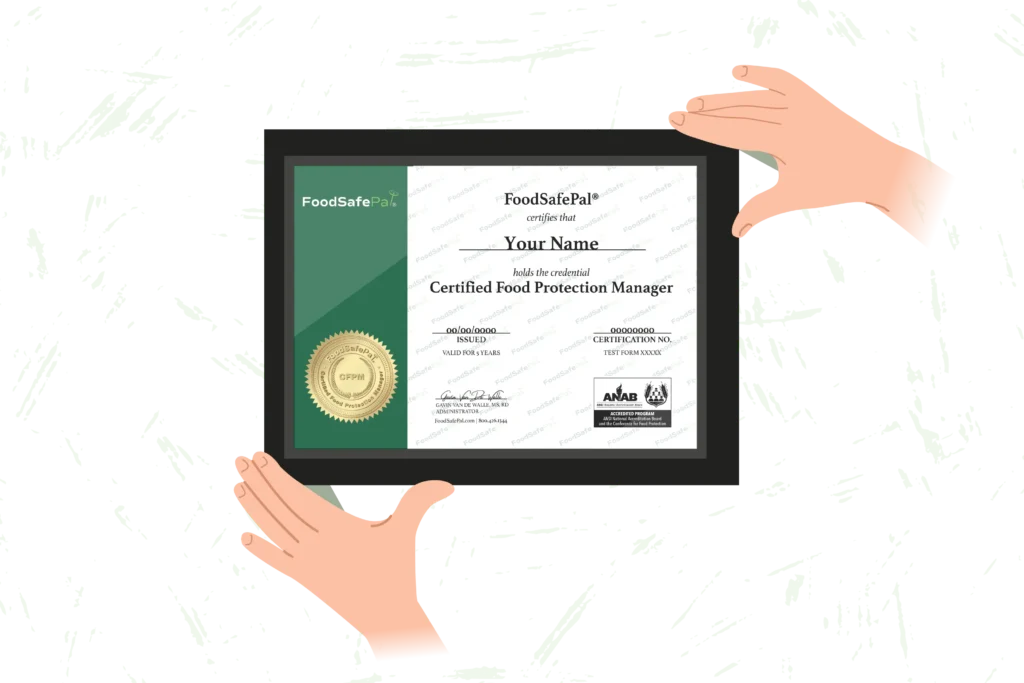
The Certified Food Protection Manager (CFPM) credential is earned by passing an exam administered by a program accredited by the ANSI National Accreditation Board (ANAB) under the Conference for Food Protection (CFP) standards.
These exams focus exclusively on food safety and regulatory compliance, including:
- preventing cross-contamination and cross-contact
- ensuring employee health and personal hygiene
- managing time and temperature controls
- cleaning and sanitizing procedures
- facility design and maintenance
- pest prevention and control
- hazard analysis and critical control point (HACCP) principles
Unlike the CDM, there are no eligibility prerequisites to sit for the CFPM exam. Anyone may register and take the exam. However, completing a food manager training course is strongly recommended to improve your likelihood of passing.
FoodSafePal offers an ANAB-CFP accredited CFPM certification exam that can be taken online with live remote proctoring. The exam consists of 70 multiple-choice questions, 10 of which are unscored pilot questions used for statistical validation. Depending on the exam form, the passing score ranges from 68% to 72%.
The exam is closed book and monitored to maintain exam security. Candidates receive two attempts and must wait 48 hours between attempts if a retake is needed.
Upon passing, candidates immediately earn the CFPM credential, which is valid for five years.
The cost of CFPM certification varies by provider but typically ranges from $75 to $150 depending on whether training is bundled with the exam.
CFPMs may work in all food establishment settings, including restaurants, healthcare facilities, schools, correctional facilities, and retail food operations.
Food Manager Certification Made Easy
Train, test, or both — completely online. Earn your Certified Food Protection Manager (CFPM) credential.
Summary
There are no prerequisites to sit for the CFPM exam. The exam typically includes around 70 to 90 multiple-choice questions and is valid for five years after passing. It is nationally recognized and required in most states for food managers or persons in charge.
CDM vs. CFPM comparison
Here’s a side-by-side comparison between the CDM and CFPM credential:
| CDM | CFPM | |
|---|---|---|
| Prerequisites to take the exam | Meet one of five pathways | None |
| Cost (excluding training material or courses) | $425 | $75–$100 |
| Number of questions | 160 multiple-choice questions (20 unscored) | 70–90 multiple-choice questions (10-20 unscored) |
| What the exam covers | • nutrition • foodservice • personnel and communications • sanitation and safety • business operations | All aspects of food safety |
| Proctored | Yes (at a testing center only) | Yes (online or at testing center) |
| Maintenance/renewal | 45 hours of continuing education every three years | Must retake the exam every five years |
| Workplace | Usually healthcare facilities and schools | All food establishments |
Summary
While many organizations may offer some type of food safety certification, only organizations accredited by the ANAB-CFP like FoodSafePal are deemed valid by health departments.
Which should you choose?
The CDM credential is designed primarily for professionals working in healthcare and institutional foodservice settings. It covers a broad scope of competencies beyond food safety, including nutrition management and business operations.
The CFPM credential, on the other hand, focuses exclusively on food safety and regulatory compliance. It is the credential most commonly required by state and local health departments for managers or persons in charge.
The Centers for Medicare and Medicaid Services (CMS) recognizes both the CDM and CFPM as qualifying credentials for certain foodservice leadership roles in healthcare facilities.
However, even individuals who earn the CDM may still be required by state or local regulation to hold an ANAB-CFP accredited CFPM credential to serve as the certified food protection manager.
Because of its national recognition and regulatory acceptance, the CFPM credential is required in nearly every state regardless of work setting.
Summary
The CDM is ideal for those pursuing leadership roles in healthcare foodservice. The CFPM is the credential most broadly required by health departments and applicable across all food establishment types.
The bottom line
The CDM and CFPM are two of the most widely recognized credentials for foodservice managers.
The CDM is specialized for healthcare and institutional foodservice professionals and includes broader competencies in nutrition and management.
The CFPM credential is nationally recognized, accredited by the ANAB-CFP, and required in most states for managers and persons in charge at food establishments.
Even individuals who earn the CDM may still need to obtain the CFPM credential to satisfy state or local regulatory requirements.
If your goal is to meet health department requirements or qualify as the certified food protection manager at your establishment, earning an ANAB-CFP accredited CFPM credential is typically the most direct and widely accepted path.
Food Manager Certification Made Easy
Train, test, or both — completely online. Earn your Certified Food Protection Manager (CFPM) credential.