Minnesota Cottage Food Law: Do You Need Food Safety Training?

Article Summary
Selling homemade food in Minnesota? The cottage food law requires completing a state-approved food safety training course every year. While not required, earning a food handlers card can still give your business an edge. This quick video explains why it’s worth it, what you’re allowed to sell, and how to get your food handler card online with FoodSafePal.
Selling homemade food can be a great way to share your products and earn extra income, but every state has its own rules you need to follow.
Each state sets its own cottage food or “homemade food” laws that define what you can make, where and how you can sell it, and whether you need food safety training.
This article explains Minnesota’s cottage food law and whether you need food safety training to sell homemade food.

Minnesota cottage food law
Minnesota’s cottage food law allows you to make and sell certain non-potentially hazardous foods from your home — or from a commercial kitchen — without a food establishment license.
Examples of non-potentially hazardous, meaning they do not support rapid bacterial growth at room temperature, include:
- Baked goods
- Candies and confections
- Dry mixes
- Certain frostings and icings that meet water-activity limits
- Home-processed and home-canned pickles, fruits, and vegetables with a pH of 4.6 or lower
- Pet treats that are baked or dehydrated and safe for cats or dogs
Minnesota does not allow you to sell:
- Foods requiring refrigeration, such as cream pies, cheesecakes, custards, or cream-filled baked goods
- Salsas, relishes, or sauces that do not meet pH or water-activity limits
- Dairy products, meat, poultry, fish, or jerky
- Infused or cannabinoid-containing products (THC/CBD)
- Foods processed in another state and transported into Minnesota for canning
- Any food requiring time or temperature control for safety
Honey and maple syrup made from a grower’s own hives or trees are exempt from cottage food registration as long as no purchased ingredients are added. If flavorings or off-farm ingredients are used, registration is required.
You can sell your products from your home, at farmers markets and community events, and through donations to fundraising events.
Customers can place orders online, but you must hand off the product directly in person.
Shipping human cottage foods is not allowed until August 1, 2027, when Minnesota’s updated law will begin allowing in-state shipping.
Pet treats may be shipped now, including out of state, as long as the producer complies with other states’ laws.
Before selling any cottage food, you must register each year with the Minnesota Department of Agriculture (MDA). Registration renews annually on April 1.
Beginning August 1, 2027, registration fees will change:
- Sales under the threshold exempt from fees — adjusted regularly for inflation
- Sales above the threshold — annual registration fee of $30
Summary
Minnesota allows a wide range of shelf-stable foods and certain home-canned goods as long as they meet pH or water-activity requirements. Refrigerated foods, meats, dairy products, and cannabinoid-containing foods are not allowed. Sales must be direct to people, and shipping will not be allowed for human foods until August 2027. Annual registration with MDA is required.
Do you need food safety training to sell homemade food in Minnesota?
Minnesota requires food safety training before you can register and begin selling cottage food.
Minnesota uses a tiered system:
- Tier 1 — For annual sales up to $7,665. You must complete the state’s free online training and pass the exam.
- Tier 2 — For annual sales from $7,666 to $78,000. You must complete a commercial food safety course approved by the Commissioner. These trainings are offered through the University of Minnesota Extension and include fees.
The annual sales limits will be adjusted for inflation.
Training must be completed every three years, and you must provide your most recent training date each time you renew your registration.
Because Minnesota requires its own training programs, FoodSafePal’s food handler course cannot replace Minnesota’s required courses.
However, if you want a nationally recognized, ANAB-accredited food handler card for farmers markets or other food-related work outside the cottage food program, you may choose to complete FoodSafePal’s course to earn your Minnesota food handler card in addition to the state-required training.
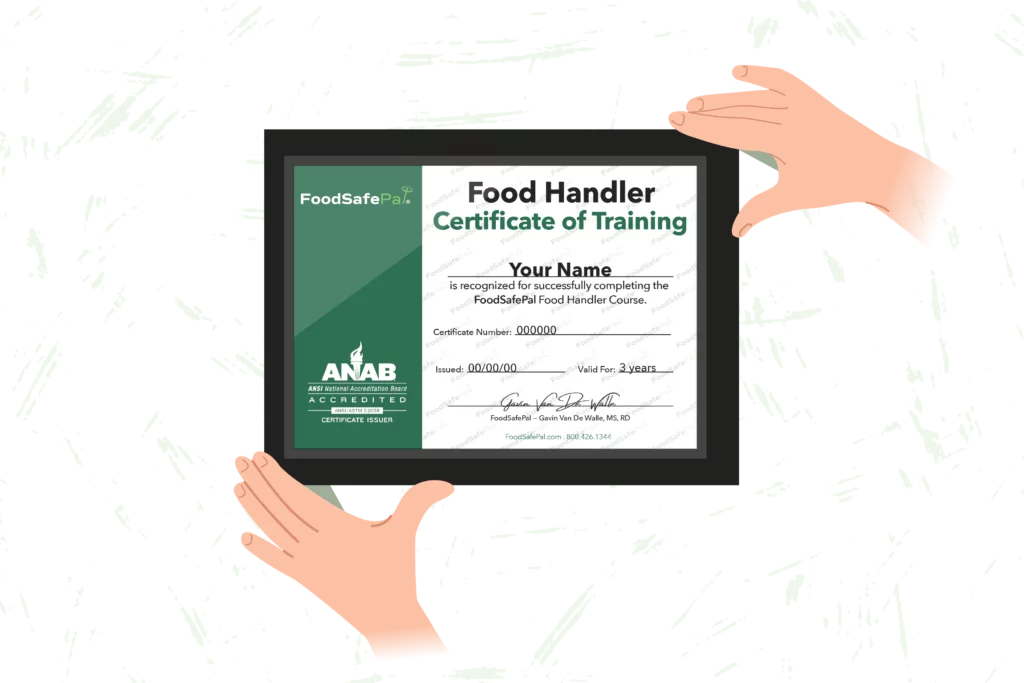
Get Your Minnesota Food Handlers Card
Instant certificate. 100% online in about 90 minutes. Does not replace Minnesota’s required food safety training.
Summary
Minnesota requires food safety training for all cottage food producers. Tier 1 sellers complete the free state training; Tier 2 sellers must take an approved safe food handling course. Training is required every three years and must be completed before registration.
Labeling requirements
Minnesota requires every cottage food product to be labeled with:
- Your full name (or registered cottage food business name)
- Your registration number or address
- The date the food was made
- A complete ingredients list in descending order by weight
- Major food allergens
- The statement: “These products are homemade and not subject to state inspection.”
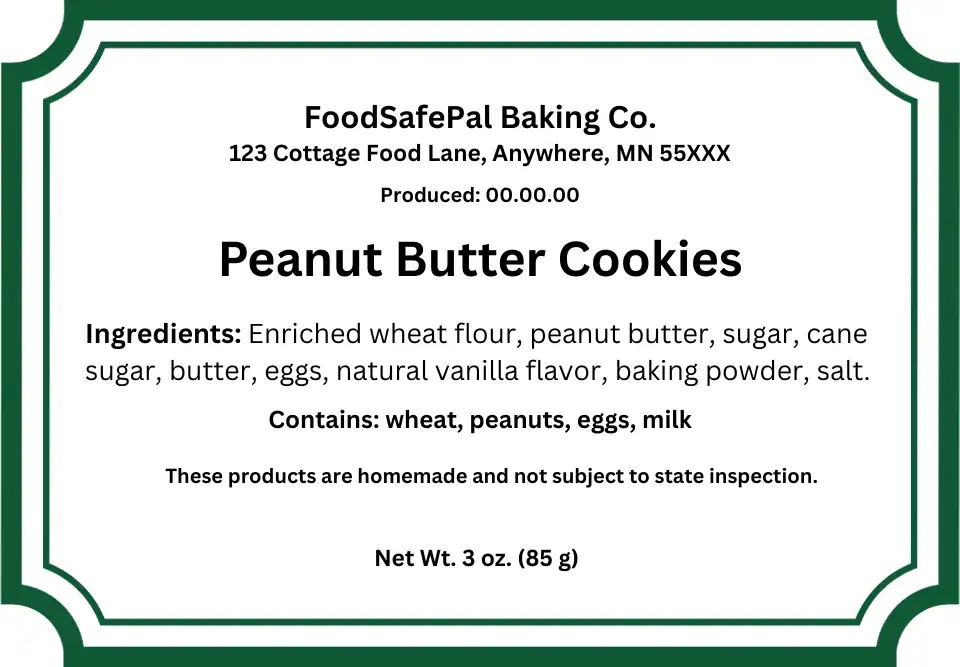
Signage displaying this same statement is required at every point of sale. For internet sales, the statement must be clearly displayed on the ordering page.
Summary
Minnesota requires detailed labels including your name, registration number or address, production date, ingredients, allergens, and the statement that the products are homemade and not inspected. This statement must also appear on signage and online listings.
The bottom line
Minnesota’s cottage food law allows many types of non-potentially hazardous foods, including certain home-canned goods, baked goods, candies, dry mixes, and pet treats. Foods requiring refrigeration are not allowed. Sales must be direct to people, and shipping for human cottage foods will only become legal within Minnesota starting August 1, 2027.
Food safety training is required for all cottage food producers, with different training based on your annual sales level. Annual registration with the MDA is required, and products must follow Minnesota’s labeling rules.
With the right training, registration, and labeling in place, Minnesota cottage food producers can legally and safely sell a wide range of homemade products to their communities.
Get Your Minnesota Food Handlers Card
Instant certificate. 100% online in about 90 minutes. Does not replace Minnesota’s required food safety training.