Do Employers Actually Verify Food Handler Cards? (The Truth)

Article Summary
Most employers require a valid food handler card and many do verify it directly with the issuing company since there is no central database. Because fake or altered cards are routinely caught and can cost you a job, the safest option is to earn an approved, ANAB-accredited card from a legitimate provider like FoodSafePal.
Most employers require a food handlers card if you work in a restaurant or any setting where food is prepared or served, including places like healthcare facilities and school kitchens.
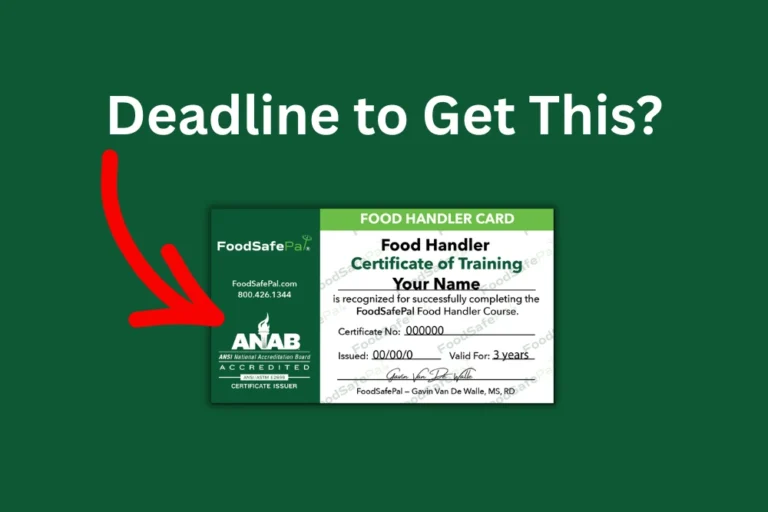
A food handlers card shows that you have completed approved food safety training and understand essential principles like preventing contamination, controlling temperatures, and maintaining proper hygiene. Knowing these basics help protect customers, patients, students, and coworkers from foodborne illness.
At the same time, a quick online search turns up countless images of food handler certificates and cards from legitimate programs. That can make some people wonder whether they could simply fill one out themselves or use a fake version. And realistically, how likely is it that a manager will actually check whether you truly earned it?
This article explains how employers verify food handlers cards, why trying to fake one using AI or other methods is a bad idea, and how to earn a valid food handlers card the right way so you don’t risk your job or future job opportunities.
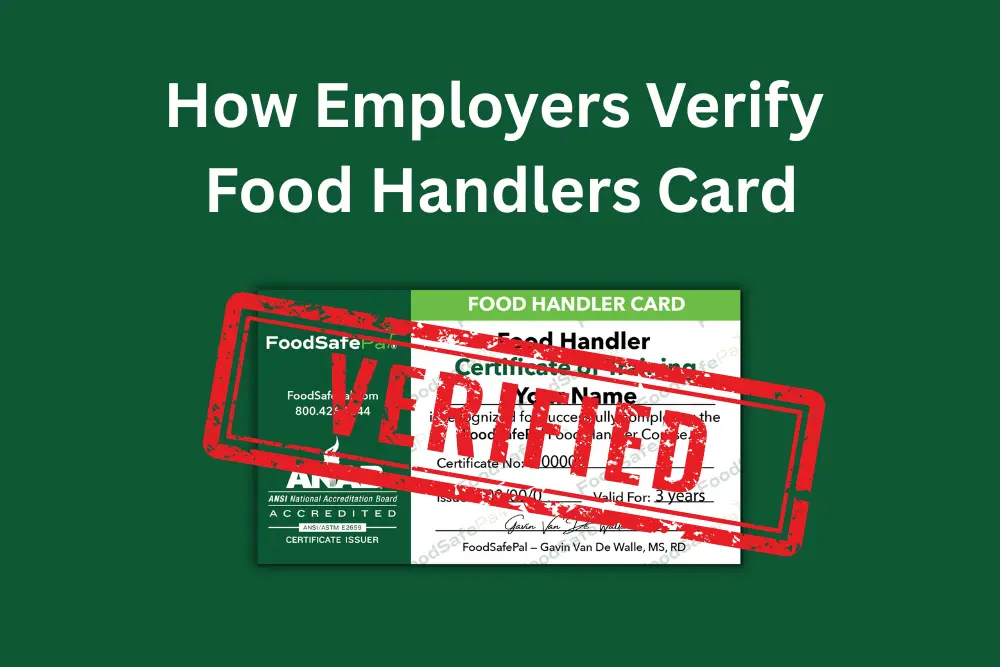
There is no central food handler card validator
Employers do verify food handlers cards, often more frequently than people expect. As the program administrator for FoodSafePal, a nationally recognized food handler card issuer, I regularly receive verification requests from employers and onboarding companies, most often by email.
In many cases, employers simply want confirmation that a card is valid and active. Below are a few real examples of the types of verification requests we receive.
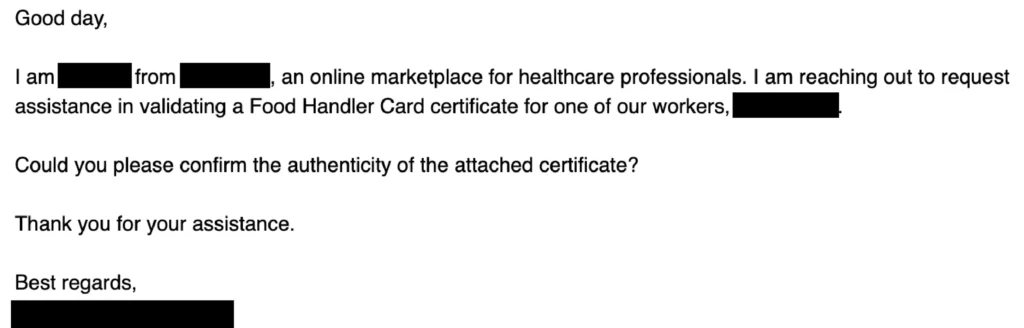
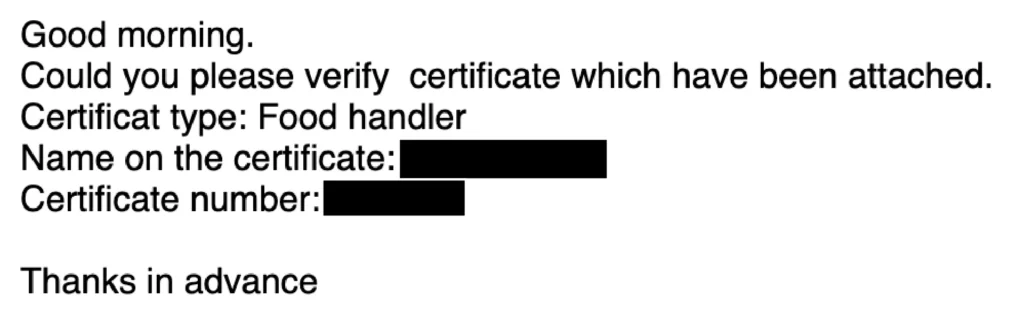
Every legitimate food handlers card, at least those issued by programs accredited by the ANSI National Accreditation Board (ANAB), is required to include specific identifying details. These include a unique certificate number, the individual’s legal name, and the date the card was earned along with its expiration date.
Those details allow the issuing program to confirm whether a card is authentic or has been altered.
What often surprises people is that there is no single, centralized database where employers can instantly verify all food handlers cards. Food handler cards are issued by individual training programs, and each program is responsible for verifying only the cards it issues.
That means verification must always be done through the original issuer. For example, if someone earned a food handlers card through ServSafe, it cannot be verified by another provider like FoodSafePal. They are different companies, issue different certificates, and maintain separate records.
Verification methods vary by provider. Some programs offer online lookup tools where employers enter identifying information to confirm a card’s status. Others use QR codes that link to a verification page. Many, including FoodSafePal, rely on direct verification through email or phone.
Requiring direct verification may seem less convenient, but it creates a clear record that the employer checked the card and received confirmation directly from the issuing program.
Unfortunately, we also receive verification requests for falsified or altered certificates. When that happens, the card is flagged as invalid and the employer is informed that it was not legitimately earned.
In most cases, attempting to fake a food handlers card does not save time or money. Many people assume it takes hours or days to complete training, when in reality most learners can earn a valid food handlers card in about 90 minutes with FoodSafePal. Trying to shortcut the process often ends up taking longer and can cost someone a job opportunity altogether.
How to get an approved food handlers card online
Because employers often verify food handlers cards, trying to use a fake or altered certificate isn’t worth the risk. Getting caught can cost you a job offer and may create issues with future employers.
The good news is that earning an approved food handlers card is straightforward and can be done online in about 90 minutes through FoodSafePal.
Earn Your ANAB-Accredited Food Handler Card in 90 Minutes
Trusted by thousands. The fastest, most reliable way to meet your health department’s requirements.
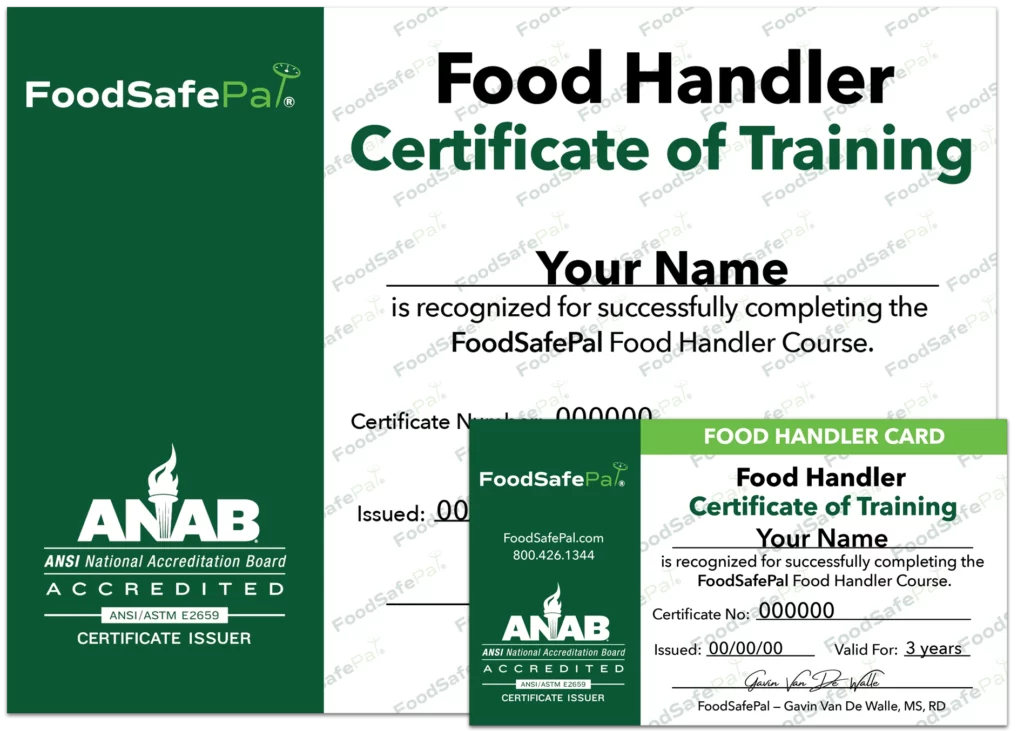
FoodSafePal’s food handler course is ANAB accredited and is accepted by most state and local health departments. That said, some jurisdictions issue their own food handlers cards and do not accept outside programs. Common examples include Alaska, New York City, New York State, and Clark County (Las Vegas), Nevada.
These restrictions are clearly communicated before enrollment. In cases where our card is not accepted, we either make that limitation explicit or prevent enrollment altogether to avoid confusion.
In all other states, earning an ANAB-accredited food handlers card through FoodSafePal is a reliable way to meet employer and health department requirements. If you don’t pass the final test on your first attempt, a free retake is included.
Once you pass, your digital food handlers card and certificate are issued immediately, allowing you to provide proof to an employer or submit it with a job application right away. You also have the option to upgrade to a professionally printed copy mailed to you.
The bottom line
Most employers require a valid food handlers card for jobs, and many do verify that the card is legitimate.
There is no central database for food handler cards, which means verification must always be done directly with the company that issued the card using details like the certificate number, name, and dates.
Because employers regularly catch falsified or altered cards, trying to fake one using AI or other methods can cost you a job or future opportunities. The safest option is to earn an approved, ANAB-accredited food handlers card through a legitimate provider, like FoodSafePal.
Earn Your ANAB-Accredited Food Handler Card in 90 Minutes
Trusted by thousands. The fastest, most reliable way to meet your health department’s requirements.