Washington DC Cottage Food Law

Selling homemade food can be a great way to share your products and earn extra income, but every state has its own rules you need to follow.
Each state, along with Washington, DC, has its own cottage food or “homemade food” laws that define what you can make, where and how you can sell it, and whether food safety training is required.
This article explains Washington, DC’s cottage food law and whether you need food safety training to sell homemade food.
Washington DC cottage food law
Washington DC allows you to make and sell non-potentially hazardous foods that don’t require time or temperature controls to stay safe.
Examples of allowed foods include:
- Baked goods (breads, biscuits, cakes, cookies, donuts, muffins, pastries, pies, pizzelles, rolls, scones, tortillas, waffle cones)
- Candy & confections (brittles, chocolates, cotton candy, fudge, toffee, truffles)
- Cereals, granola, & trail mixes • Dried & packaged goods (dry baking mixes, dry herbs & seasonings, dried pasta, dry tea blends)
- Jams, jellies, marmalades, preserves, syrups, vinegars, & honey
- Roasted coffee (whole bean or ground)
- Snacks (caramel corn, crackers, nuts & dried fruits, popcorn, pretzels, seeds)
Washington DC maintains an approved product list. If you want to make a product not on this list, you must submit confirmation of the product’s pH and water activity from an accredited laboratory to DC health for review and approval.
You must sell your products directly to people within the district from your home or at farmer’s markets and public events. You cannot sell to restaurants or grocery stores.
Before you can sell, you must pass an inspection from the DC health department and obtain a cottage food business registry number.
Summary
Washington DC allows cottage food production only for approved, shelf-stable foods sold directly to consumers. You cannot make and sell anything that require refrigeration or otherwise pose higher food safety risks are not allowed.
Do you need food safety training to sell homemade food in Washington DC?
Washington DC requires you to pass a food manager exam that is accredited by the ANSI-National Accreditation Board (ANAB) under the Conference for Food Protection Standards (CFP) to sell homemade food.
Passing this exam earns you the official Certified Food Protection Manager (CFPM) credential.
That national certification is the key to one more required step. You’ll need to use it to apply for your DC Health-issued Certified Food Protection Manager Card, or CFPM Card. Without the national certificate from passing an accredited exam, you cannot obtain the DC Health Card. Once you have your certificate in hand, applying for your DC Health CFPM Card is done online through the district’s health website.
Only a handful of organizations are approved to offer the accredited food manager exam, and FoodSafePal is one of them.
Washington DC Food Manager Certification (CFPM)
Washington DC Cottage Food Law Approved
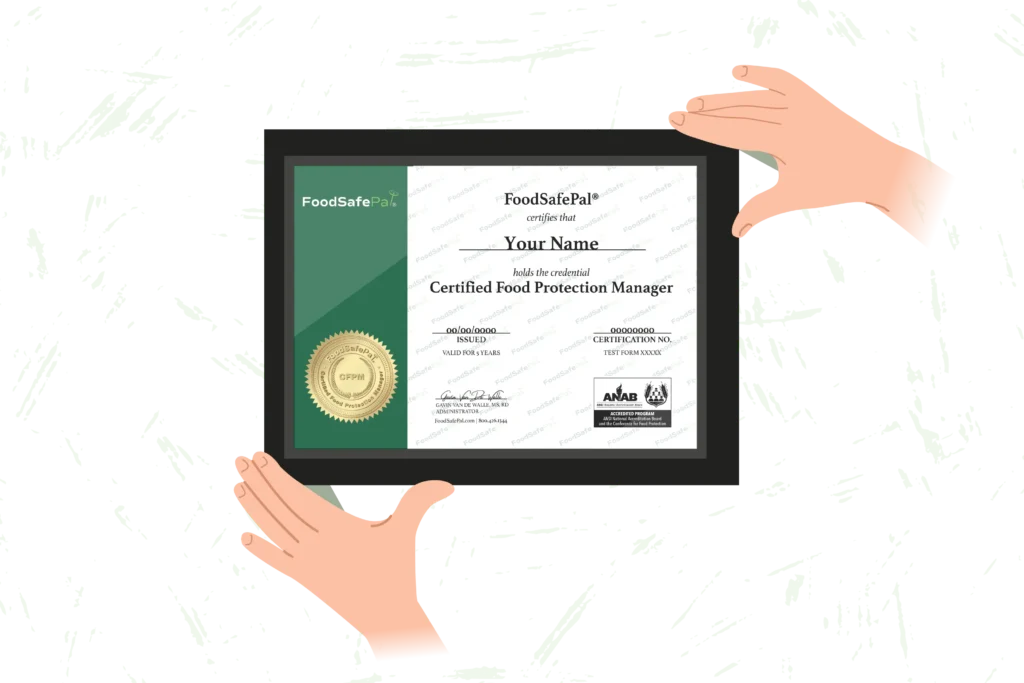
With FoodSafePal, you have three clear paths towards certification. You can choose training only if you want to prepare now and take the exam later. You can choose the exam only if you already feel ready. Or you can choose the bundle, which includes both.
FoodSafePal’s exam is taken online with live remote proctoring from any quiet, private location. It’s closed book — no notes, no phone, no outside help. Your purchase includes two attempts, so if you don’t pass the first time, you wait 48 hours, review your weak areas, and try again at no additional cost.
Once you pass, your national food manager certification is issued as soon as your exam session is verified and available right in your dashboard to download or print.
When you pass the accredited exam through FoodSafePal, your national food manager certification is valid for five years. However, in DC, when you use that national certificate to apply for your DC Health-issued CFPM Card, the card is valid for three years from the date of your exam.
So while your national credential lasts five years, you should plan around a three-year renewal cycle to keep your DC Health Card current. When it’s time to renew, you’ll retake and pass the accredited exam and then use that to reapply for your DC Health CFPM Card.
Summary
Washington DC requires you to earn food manager certification from an accredited organization like FoodSafePal. Once you have your certification, you’ll apply for your DC Health-issued CFPM card. You must renew this card every three years to keep it active.
Labeling requirements in Washington DC
Washington requires all cottage food products to be properly labeled so consumers know what they are purchasing.
Each label must include:
- The name of the food product
- The cottage food business identification number
- A complete ingredient list in descending order by weight, including sub-ingredients
- Allergen information
- Net weight or net volume
- The required statement in at least 10-point type: “Made by a cottage food business that is not subject to the District of Columbia’s food safety regulations
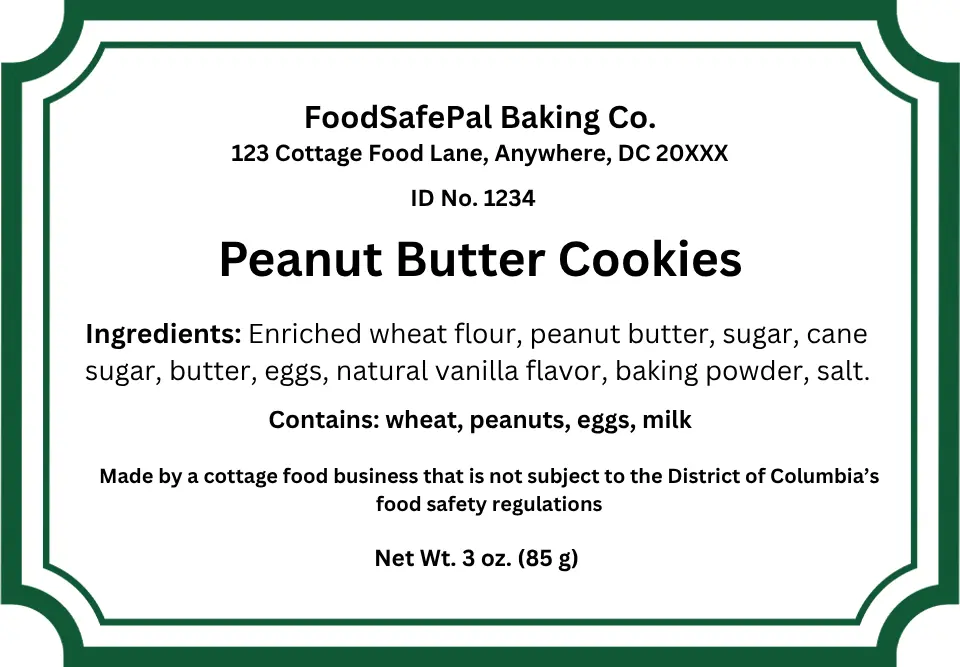
If you make any nutritional claims, such as low fat or sugar-free, you must follow federal labeling requirements.
Summary
Every cottage food product sold in Washington DC must include clear labeling with product details, ingredients, allergens, ID number, net quantity, and the required home kitchen disclosure.
The bottom line
Washington DC allows you to make and sell foods directly to people within the district that don’t require time or temperature controls to stay safe.
Before you can start your business, you must have your home kitchen inspected and obtain an identification number from DC Health.
You must also earn your food manager certification from an accredited organization like FoodSafePal, which you’ll use to apply for your DC Health-issued CFPM Card.
All products must be labeled with the required information.
Washington DC Food Manager Certification (CFPM)
Washington DC Cottage Food Law Approved