How to Tell Whether a Food Handlers Card Is Legit

Article Summary
There is no universal database where you can verify a food handler card. Some providers offer internal verification for their own cards, but this does not confirm acceptance by your local health department. This article explains how to verify both, and how to spot red flags that often lead people to choose a card that isn’t actually accepted.
If you’ve been told you need a food handler card — whether to work at a food establishment or sell homemade food — it’s reasonable to assume that any provider offering one online will work.
After all, most of them make the same claims of approval, speed, and acceptance. But, those claims aren’t always true.
Food handler card acceptance is controlled by state and local health departments, and many only recognize cards from specific providers or programs. Earning a card from an unrecognized organization or non-accredited course can mean wasted time, wasted money, and delays in starting work or selling food.
What makes this especially confusing is that there’s no single national database or universal standard that you can easily check. Two courses may look nearly identical online, yet only one may actually accepted where you live.
As the program administrator for FoodSafePal, I’ve spent years reviewing state and county food handler requirements, working directly with health departments, and seeing firsthand why cards get rejected. Based on that experience, this article walks through how to tell whether a food handler card is legitimate — and how to avoid common mistakes that lead people to choose the wrong one.
Look for ANAB Accreditation (But Don’t Stop There)
Food handler training programs accredited by the ANSI National Accreditation Board (ANAB) have gone through an independent, third-party review process. That review evaluates whether the course and exam meet nationally recognized standards for things like content accuracy, exam quality, and consistency.
Because of that oversight, ANAB accreditation is the strongest and only signal that a food handler program is legitimate and professionally developed. It also prevents companies from simply creating a course and self-declaring that it’s valid or accepted.
In practice, many states, counties, and employers either require or strongly prefer ANAB-accredited food handler cards. That said, accreditation alone does not guarantee acceptance everywhere, which is why it’s important to verify local requirements as well.
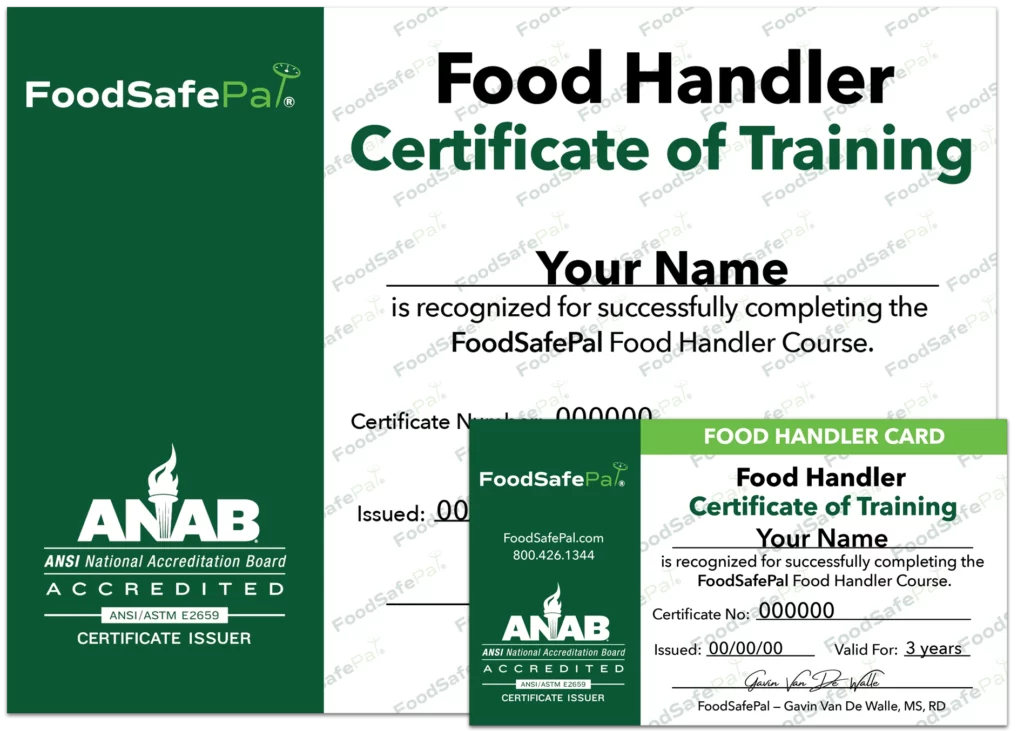
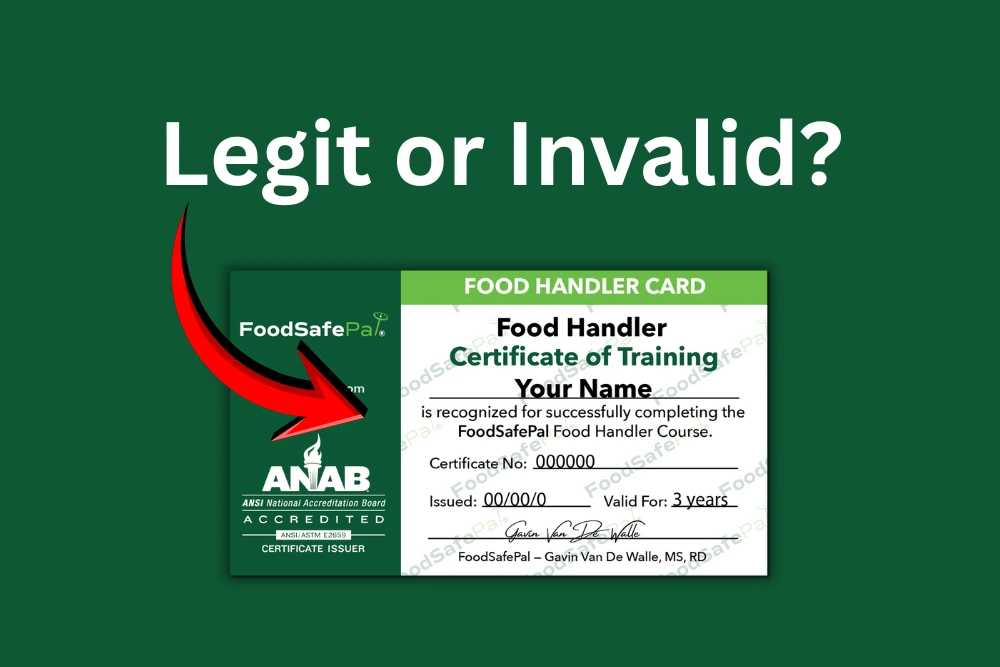
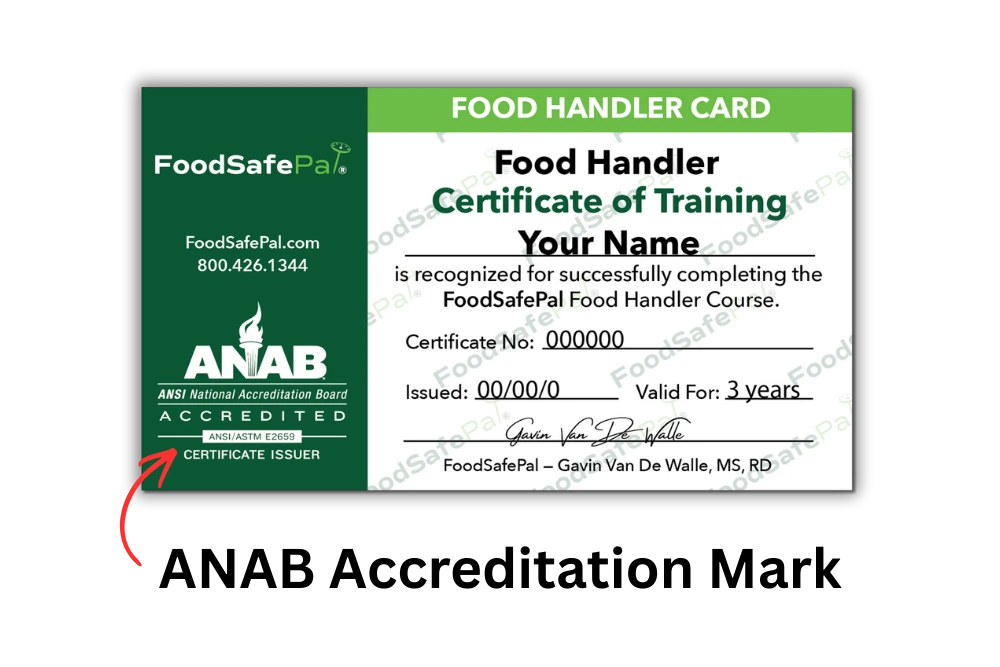
If a food handler card is ANAB-accredited, the accreditation mark will appear directly on the certificate or wallet card.
You can also confirm a provider’s status by checking the public directory of currently accredited food handler programs on ANAB’s website. FoodSafePal is listed there.
Verify State- or County-Specific Acceptance
ANAB-accredited food handler cards are widely accepted, but accreditation alone does not guarantee acceptance in every location. Food handler requirements are ultimately set at the state or local level, and some jurisdictions have additional rules that override national accreditation.
For example, Utah has its own food handler course approval process. Training providers must be individually approved by the state before offering food handler education, largely because Utah includes state-specific food safety requirements.
Other states, such as Washington and Alaska, operate their own food handler training programs and do not accept third-party courses, even if they are ANAB-accredited.
In some cases, acceptance is determined at the county level. Certain counties in California and Oregon contract with a single approved provider, making that provider the only option accepted locally.
Because of these variations, it’s important to confirm acceptance based on where you live or work — not just whether a course is accredited. Legitimate providers should clearly disclose where their food handler card is and isn’t accepted, rather than leaving learners to discover issues after completing the training.
There is no universal database where you can verify a food handler card. Some providers offer internal verification for their own cards, but this does not confirm acceptance by your local health department.
FoodSafePal publishes this information upfront so learners can verify acceptance before enrolling and avoid wasting time or money on a card that won’t be recognized.
Red Flags That a Food Handlers Card May Not Be Legit
There is no shortage of food handler card providers online, and some are very good at appearing legitimate at first glance. That’s why it’s important to look beyond marketing language and focus on a few concrete signals.
One of the biggest red flags is a provider that does not hold ANSI National Accreditation Board accreditation but relies on vague phrases like “health department accepted,” “approved,” or “recognized” without clearly stating by whom or where. Without accreditation, there is no independent oversight preventing a company from self-declaring validity.
Another red flag is the lack of clear disclosure about where a food handler card is accepted. Even accredited programs are not accepted everywhere, and legitimate providers should clearly state any known state or local limitations before you enroll. If you have to dig through fine print or only learn about acceptance issues after completing the course, that’s a problem.
A related concern is when the full responsibility for verifying acceptance is placed entirely on the learner. While acceptance does vary by location, reputable programs take ownership of communicating where their cards are and are not valid, rather than shifting that burden onto the consumer.
FoodSafePal publishes acceptance information upfront so learners can confirm whether the card meets local requirements before enrolling, instead of discovering issues after the fact.
The bottom line
Not all food handler cards are accepted everywhere, even if they look the same online. Whether a card is legitimate depends on two things: the course must be properly accredited, and the card must be accepted where you live or work.
ANAB accreditation is the strongest sign that a food handler course meets national standards, but it’s not the only step. Some states and counties have their own rules, and a card that’s accepted in one place may not be accepted in another.
The safest approach is to choose a provider that is clear about both accreditation and acceptance. Legitimate programs explain where their card is accepted and point out any limits before you enroll. If that information is hard to find or only shows up after you finish the course, that’s a red flag.
If you’re ready to earn a food handler card, FoodSafePal offers ANAB-accredited training and clearly lists where its card is and isn’t accepted, so you can check first and avoid wasting time or money.
Earn or Renew Your Food Handler Card in 90 Minutes
Trusted by thousands. The fastest, most reliable way to meet your health department’s requirements.