Missouri Cottage Food Law: Do You Need Food Safety Training?

Article Summary
Selling homemade food in Missouri? The cottage food law doesn’t require food handler training, but getting your card can still give your business an edge. This quick video explains why it’s worth it, what you’re allowed to sell, and how to get your food handler card online with FoodSafePal.
Selling homemade food can be a great way to share your products and earn extra income, but every state has its own rules you need to follow.
Each state sets its own cottage food or “homemade food” laws that define what you can make, where and how you can sell it, and whether you need food safety training.
This article explains Missouri’s cottage food law and whether you need food safety training to sell homemade food.
Missouri cottage food law
Missouri’s cottage food law allows you to make and sell certain low-risk foods from your home without a food establishment license or routine inspections. To qualify, your products must be non-potentially hazardous, meaning they must be shelf-stable and safe at room temperature.
Missouri’s cottage food law is narrower than many states. You may sell only:
- Baked goods
- Canned jams and jellies
- Dried herbs and dried herb mixes
These foods must remain non-potentially hazardous. For example, jams and jellies must be traditional fruit-based products — pepper jellies, reduced-sugar recipes, or anything that changes acidity may no longer qualify.
Missouri does not allow cottage food producers to sell:
- Cut fruits or vegetables
- Baked goods requiring refrigeration, including cream pies or cheesecakes
- Salsas, pickles, relishes, hot sauces, or other acidified foods
- Sauces, dressings, condiments, or canned vegetables
- Dairy products, meat, poultry, fish, or jerky
- Beverages such as kombucha, juices, or cider
- Any food requiring time or temperature control for safety
You can sell directly to people at farmers markets, community events, roadside stands, and from your home. Missouri also allows online ordering, but the product must be delivered in person by you or a household member. Shipping and wholesale are not allowed.
Missouri has no annual sales limit under the cottage food law.
Summary
Missouri allows only baked goods, traditional fruit jams and jellies, and dried herbs or herb mixes to be made and sold from a home kitchen. Foods requiring refrigeration or specialized processing are prohibited. Sales must be direct to consumers, and shipping or wholesale is not allowed.
Do you need food safety training to sell homemade food in Missouri?
Missouri’s cottage food law does not require food safety training or a Missouri food handler card. However, some local health agencies require food handler training for certain food businesses.
Still, even if it’s not required, having training in place can benefit you and your customers.
When someone buys your product, they want to feel confident that it was prepared safely. Completing a food handler course shows that you understand basic food safety practices and that you take their health — and your business — seriously.
Some markets or event organizers may also ask for proof of training as part of their vendor requirements. Insurance providers commonly expect food safety training before issuing coverage or may offer better rates when you have it.
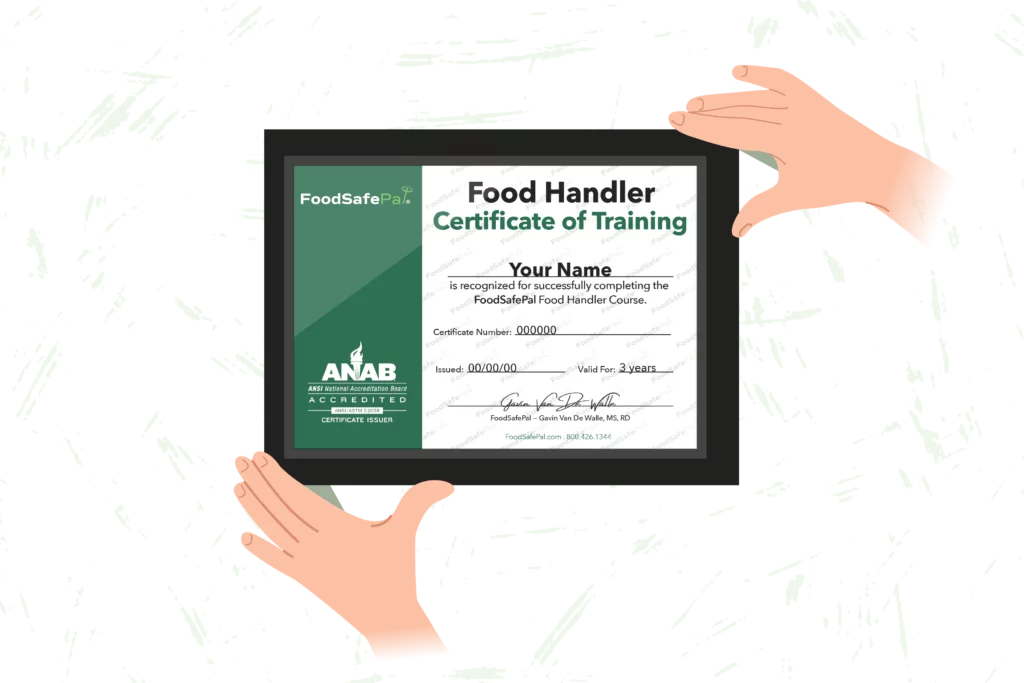
If you choose to get trained, look for a course accredited by the ANSI National Accreditation Board (ANAB), which ensures it meets nationally recognized food safety standards.
FoodSafePal’s Food Handler course is ANAB accredited, fully online, and takes about 90 minutes to complete. Once done, you’ll receive instant digital access to your card and certificate, plus the option to order a printed version for your records.
Get Your Missouri Food Handlers Card
Instant certificate. 100% online in about 90 minutes.
Summary
Missouri doesn’t require food safety training to sell homemade goods, but getting an ANAB-accredited food handler card from FoodSafePal can strengthen your business, build customer trust, and help you meet expectations from event organizers or insurance providers.
Labeling requirements
Missouri requires cottage food operators to label every product before sale.
Each label must include:
- Your full name and address
- The product name
- Ingredients in descending order by weight
- Allergen information
- Net weight or volume
- The required statement:
“This product is prepared in a kitchen that is not subject to inspection by the Department of Health and Senior Services.”
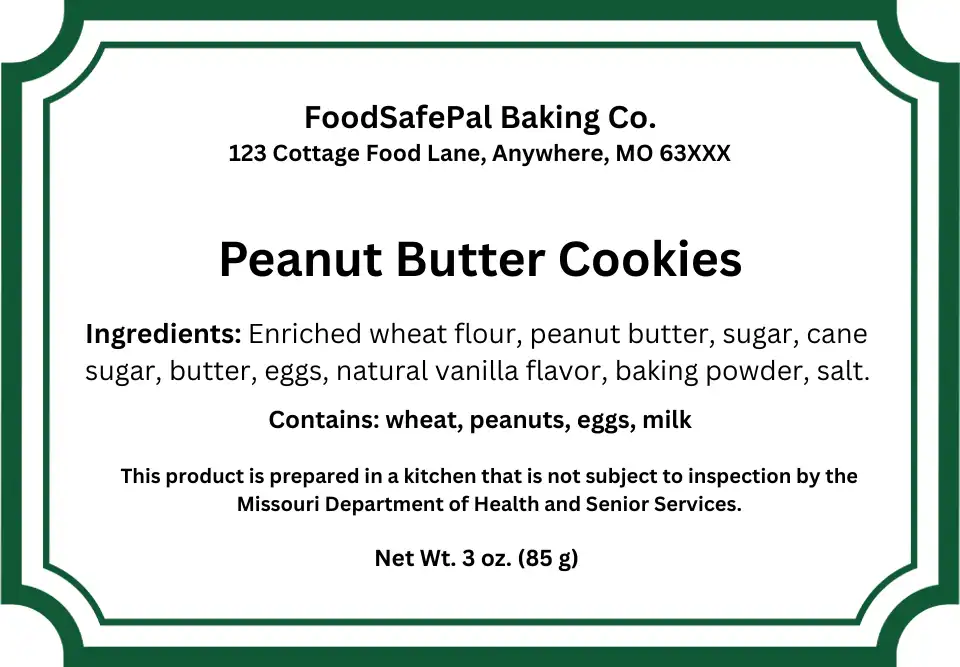
Some counties require the county health department name to appear in this statement. Check local rules for exact wording.
For large or unpackaged items such as wedding cakes, you may provide the required information on a label sheet or invoice given directly to the customer.
Summary
Missouri requires your name and address, product name, ingredients, allergens, net weight, and a home-kitchen disclosure on every label.
The bottom line
Missouri’s cottage food law allows you to sell a limited list of shelf-stable foods — baked goods, jams and jellies, and dried herbs — directly to consumers without a license or inspection. Foods that require refrigeration or special processing are not allowed, and products cannot be shipped or sold wholesale.
State law does not require food safety training for cottage food operators, but some counties, cities, farmers markets, or events may set their own training expectations. Completing an ANAB-accredited food handler course from FoodSafePal can help you meet local requirements, strengthen customer trust, and demonstrate safe handling practices.
Each product must include a label with the required information, including the statement that it was prepared in a kitchen not subject to inspection.
Get Your Missouri Food Handlers Card
Instant certificate. 100% online in about 90 minutes.