Mississippi Cottage Food Law: Do You Need Food Safety Training?

Article Summary
Selling homemade food in Mississippi? The cottage food law doesn’t require food handler training, but getting your card can still give your business an edge. This quick video explains why it’s worth it, what you’re allowed to sell, and how to get your food handler card online with FoodSafePal.
Selling homemade food can be a great way to share your products and earn extra income, but every state has its own rules you need to follow.
Each state sets its own cottage food or “homemade food” laws that define what you can make, where and how you can sell it, and whether you need food safety training.
This article explains Mississippi’s cottage food law and whether you need food safety training to sell homemade food.
Mississippi cottage food law
Mississippi’s cottage food law allows you to make and sell certain low-risk foods from your home kitchen without a food establishment license or routine inspections. To qualify, your products must be non-potentially hazardous. In other words, they must be shelf-stable, safe at room temperature, and not require refrigeration even after opening.
The state allows a relatively wide range of cottage food products, including:
- Candy
- Fruit pies
- Nut mixes and popcorn
- Dried fruit (except melons)
- Vinegar, mustard, and waffle cones
- Granola, cereal, and trail mixes
- Air-dried hard-cooked eggs with the shell left intact
- Dried pasta, dried spices, dry baking mixes, and dry rubs
- Jams, jellies, and preserves that meet federal standards
- Chocolate-covered nonperishable foods, such as pretzels, nuts, and fruit (except melons)
- Baked goods without cream, custard, meat, or other perishable fillings, such as breads, biscuits, cookies, pastries, and tortillas
- Certain acidified foods, such as properly acidified pickles or vegetables that meet federal rules for pH and processing
Acidified and canned products come with additional responsibility. These foods must meet strict federal standards for acidity, sugar content, and processing to prevent botulism and other serious foodborne illnesses. The state strongly recommends additional training and pH testing for anyone making acidified or fermented products.
Mississippi does not allow cottage food producers to sell higher-risk products, including:
- Sliced melons
- Raw seed sprouts
- Fruit or vegetable juices
- Beverages or other liquid foods
- Meat, fish, poultry, and seafood
- Garlic or fresh herbs stored in oil
- Eggs, except air-dried hard-cooked eggs in the shell
- Cooked beans, legumes, potatoes, rice, or vegetables
- Dairy products, including custard pies and other refrigerated desserts
- Pasteurized or pre-cooked foods that need temperature control for safety
- Low-acid canned foods, such as canned vegetables, meats, and seafood that require pressure canning
You can sell your products only within Mississippi and only directly to the final customer from your home or at farmers markets, municipal or county fairs, and similar community events.
You may advertise your products online, including through a website or social media, but you cannot complete sales online, ship products, or sell through third-party platforms. Shipping through the mail, wholesale sales to restaurants or stores, and consignment in retail locations are not allowed.
Summary
Mississippi allows a broad list of shelf-stable foods to be made and sold from a home kitchen, including baked goods, candies, dried foods, jams and jellies, and certain properly acidified products. Foods requiring refrigeration, pressure canning, or time and temperature control for safety are not allowed. Sales must be direct to consumers within the state and cannot be shipped or wholesaled.
Do you need food safety training to sell homemade food in Mississippi?
Mississippi’s cottage food law does not require food safety training or a Mississippi food handler card to operate a cottage food business. Cottage food operators are exempt from the training and inspection requirements that apply to licensed food establishments.
However, the state strongly encourages food safety training, especially if you will be making acidified or pickled products. Improper acidification or canning can create conditions for botulism, a rare but often deadly form of food poisoning. Training helps you understand safe recipes, correct processing times, and how to verify that products meet pH and safety targets.
Even beyond acidified foods, there are good reasons to complete a basic food safety course.
When people buy from you, they want to feel confident that the food they buy was prepared and handled safely. A food handler card shows that you understand cross-contamination, allergen control, cleaning and sanitizing, and safe storage.
Plus, some farmers markets, events, or insurance providers may ask for proof of basic food safety training as a condition of participation or coverage.
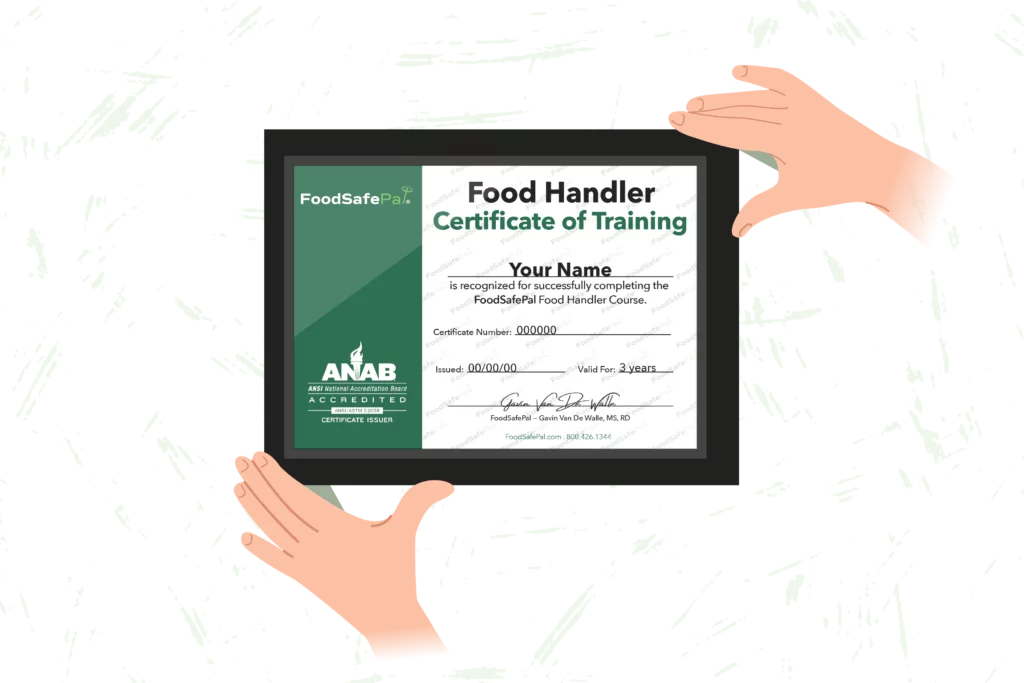
If you choose to get trained, look for a course accredited by the ANSI National Accreditation Board (ANAB). ANAB accreditation means the course meets nationally recognized food safety standards and is widely accepted by food businesses and health departments.
FoodSafePal’s Food Handler course is ANAB accredited, fully online, and takes about 90 minutes to complete. Once done, you receive instant digital access to your card and certificate, with the option to order a printed version for your records or to display at your booth.
Get Your Mississippi Food Handlers Card
Instant certificate. 100% online in about 90 minutes.
Summary
Mississippi does not require food safety training for cottage food operators, but training is strongly encouraged. Earning your an ANAB-accredited food handler card from FoodSafePal can strengthen your business, support safer practices, and help you meet expectations from markets, events, or insurers.
Labeling requirements
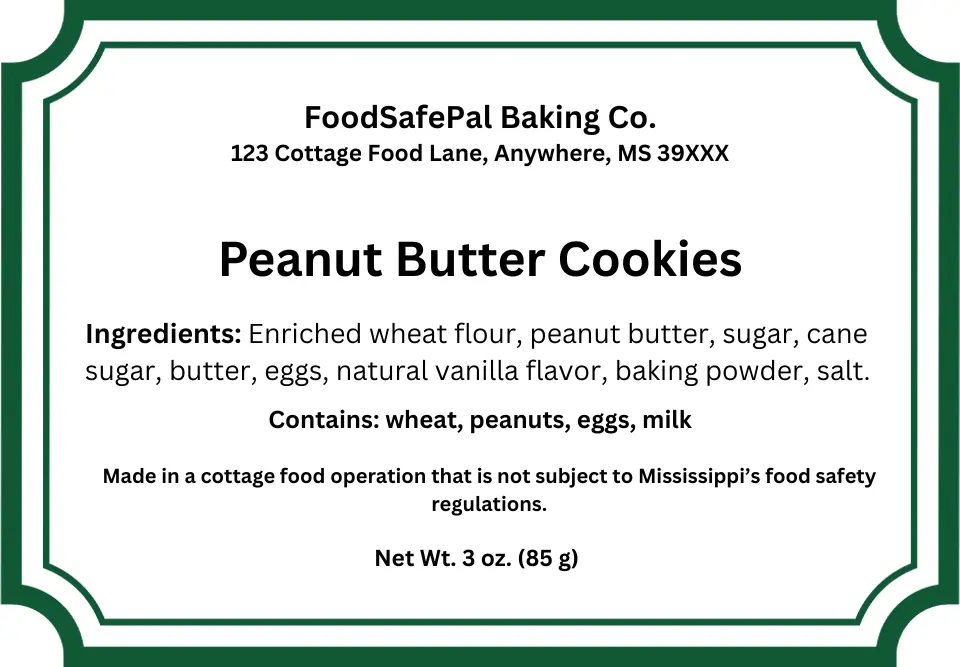
Mississippi requires you to label every product before sale. Labels help customers understand what they are buying, identify allergens, and recognize that the food was prepared in a home kitchen.
Each label must include:
- The name and address of your cottage food operation
- The name of the cottage food product
- Ingredients listed in descending order by weight, including sub-ingredients when needed
- Allergen information
- The net weight or net volume of the product
- The required statement, printed in at least 10-point type:
“Made in a cottage food operation that is not subject to Mississippi’s food safety regulations.”
If you make any nutrition or health-related claims, such as “low sugar,” “high fiber,” or “good source of vitamin C,” you must also include a complete Nutrition Facts panel and meet all federal requirements for those claims. Because this adds complexity and cost, many cottage food operators choose not to make nutrition or health claims on their labels.
For large or unpackaged items, such as wedding cakes, you may provide the required labeling information on an invoice or information sheet given directly to the customer.
Summary
Mississippi requires every cottage food product to be labeled with your operation’s name and address, the product name, ingredients, allergens, net weight or volume, and a home-kitchen disclosure. Additional nutrition labeling is required if you make nutrition or health claims.
The bottom line
Mississippi’s cottage food law allows you to start a small home-based food business making low-risk, shelf-stable products from your own kitchen. You can sell items like baked goods, candies, dried foods, jams, jellies, and properly acidified products directly to people at home, farmers markets, and local events.
Foods that require refrigeration, pressure canning, or time and temperature control for safety are not allowed, and you cannot ship, wholesale, or sell through retail stores or restaurants.
The state does not require food safety training for cottage food operators, but it is strongly encouraged. Earning your ANAB-accredited food handler card from FoodSafePal can help you better protect your customers, support your compliance with best practices, and build trust in your business.
Every product you sell must be labeled with the required information, including the statement that it was made in a cottage food operation not subject to Mississippi’s food safety regulations.
Get Your Mississippi Food Handlers Card
Instant certificate. 100% online in about 90 minutes.