Iowa Cottage Food Law: Food Safety Training Requirements

Article Summary
Selling homemade food in Iowa? You’ll need to follow the state’s Home Food Processing Establishment (HFPE) law — and that includes completing an approved food handler training course. This short video explains exactly who needs training, what foods you can sell, and how to get your card online with FoodSafePal.
People nationwide are making food at home to sell in their communities.
This homemade or “cottage food” industry is growing in popularity as consumers take a greater interest in where their food comes from and how it’s made.
Each state has specific guidelines related to the sale of homemade foods, including guidelines related to food safety training.
This article discusses the Iowa cottage food law, and whether you need food safety training to sell homemade food.

Cottage foods vs. home food processing establishments
Iowa has two regulatory categories for homemade foods — cottage foods and home food processing establishment (HFPE).
Cottage foods include most foods those that don’t require time or temperature controls to keep them safe, provided they meet certain labeling requirements.
You don’t need a license to sell cottage foods in Iowa, but you must sell directly to consumers or, if owned by the producer, at a temporary food establishment.
Conversely, to sell foods as an HFPE, you need a license through the Iowa Department of Inspection and Appeals (DIA), which replaces the home bakery license and adds the ability to make, package, and process additional food products.
Here’s a quick overview of the food varieties you can sell as cottage food or as an HFPE (1):
| Food | Iowa Cottage Food | HFPE |
|---|---|---|
| Shelf-stable food | Yes | Yes |
| Refrigerated baked goods | No | Yes |
| Certain meats and poultry products | No | Yes |
| Acidified or pickled foods | Yes | No |
| Low-acid canned goods | No | No |
| Fermented foods | No | Yes |
The state allows you to determine which category you fit into based on the food you sell.
In some instances, you might sell some food that falls under the cottage food law, and others that fall under the HFPE law, but you must keep your records and sales separate.
Summary
Iowa allows you to sell cottage foods without a license, but you need one to sell as an HFPE. Iowa allows you to choose which regulation you fit into based on what you sell.
Do you need food safety training to sell homemade foods in Iowa?
Unsafe food handling by food workers is a leading cause of contamination and consequently foodborne illnesses.
Any food can become contaminated but foods that require time and temperature controls such as dairy products, meats, poultry, seafood, and cut vegetables and fruits are especially prone to contamination since they may carry disease-causing organisms called pathogens like bacteria.
As such, many states and food establishments require food safety training — also known as food handler training — for food workers so they have the knowledge necessary to handle food safely.
While Iowa doesn’t require food safety training to sell cottage foods, you must before you sell foods as an HFPE.
This is because with an HFPE license you can sell more types of foods — specifically those that require time and temperature controls — that are prone to contamination.
Therefore, it’s important to know how to handle them safely to keep your customers safe but also to prevent lawsuits in the event your food made people sick.
Iowa accepts ANSI-National Accreditation Board (ANAB)-accredited food handler training like FoodSafePal’s to meet the training requirements for HFPEs.
Earn Your Food Handlers Card + Certificate to Sell Cottage Foods
Finish in 90 Minutes. Meets Iowa’s Cottage Food Law.
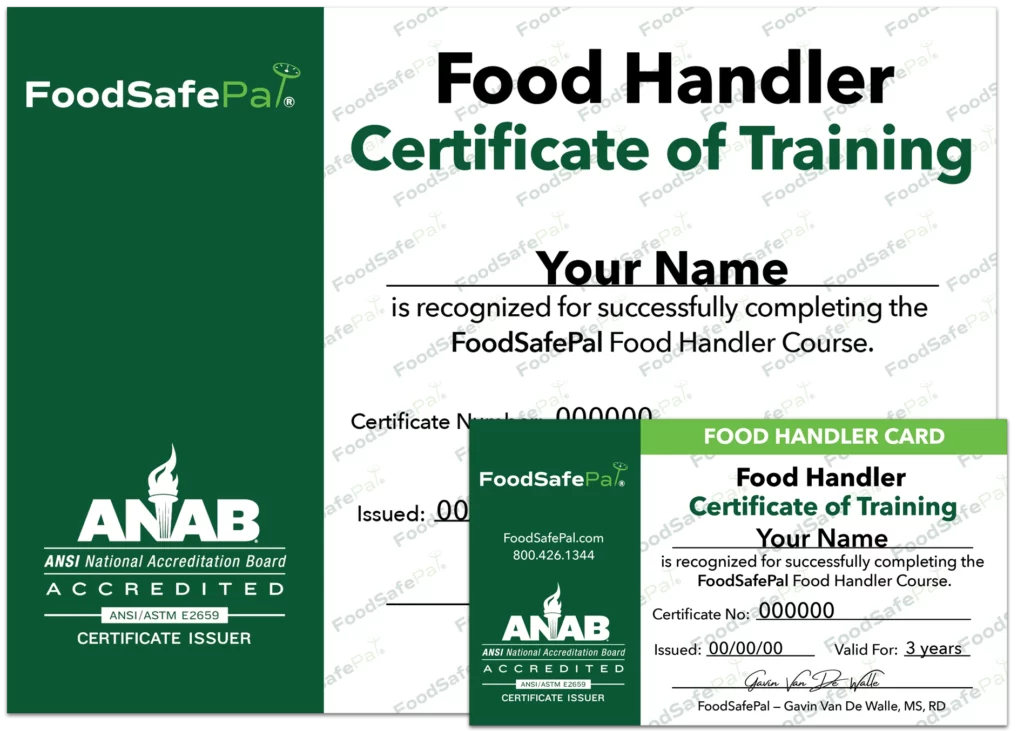
FoodSafePal’s food handler training is completely online, and you can learn and test in under two hours.
After you pass, you can download or print your Iowa food handler card and certificate and include it in your application for an HFPE license.
Summary
You need food safety training to obtain an HFPE license, but not if you plan to sell food under the Iowa cottage food law. Iowa accepts ANAB-accredited food handler training to meet this requirement.
Labeling requirements
Iowa requires specific information to appear on the label of every product sold under the cottage food law or the HFPE law. The requirements are different depending on which category you fall under.
Cottage food labeling
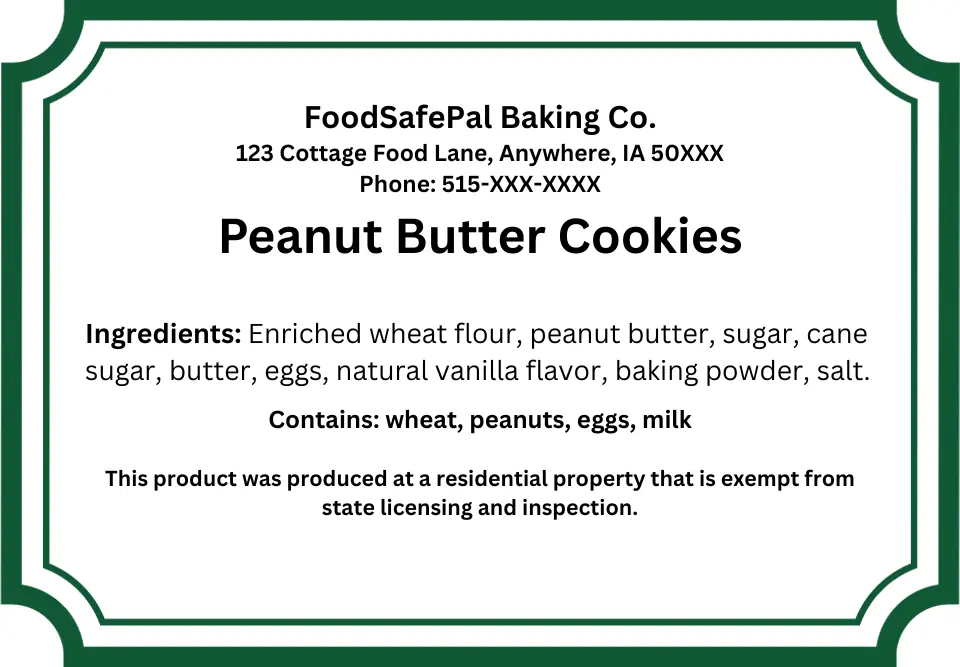
Cottage foods must include the following on the label or on a clearly visible placard at the point of sale:
- The name and address, phone number, or email address of the person preparing the food
- The common name of the food
- The ingredients in descending order of predominance
- Allergen information
- The required statement: “This product was produced at a residential property that is exempt from state licensing and inspection”
If the product contains home-canned pickles, vegetables, or fruits allowed under the law, the date the food was processed and canned.
HFPE labeling
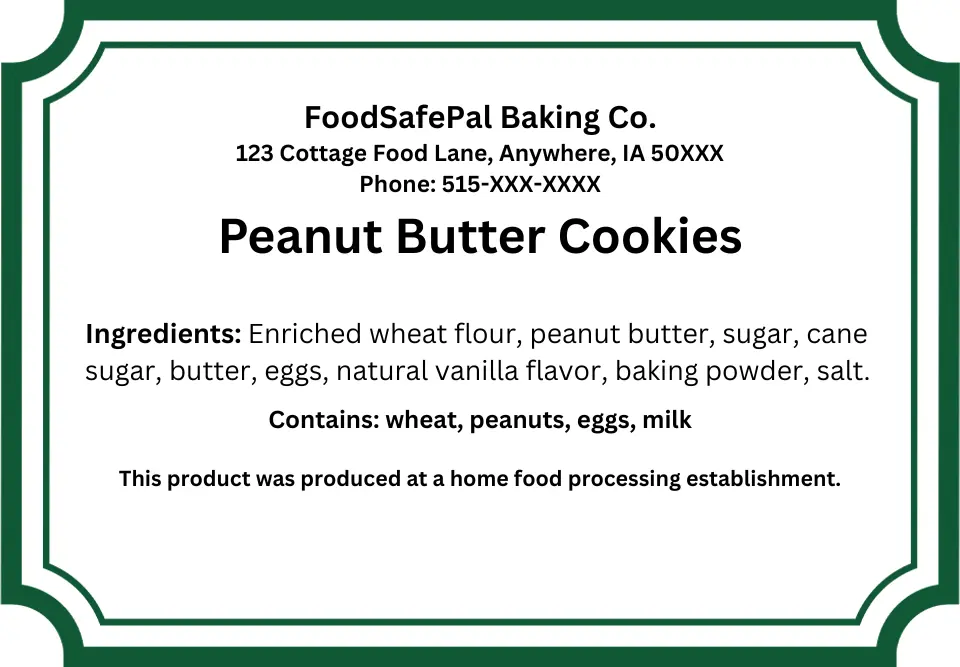
If you operate as an HFPE, your products must be labeled with:
- The name of the home food processing establishment
- The common name of the food
- The ingredients in descending order of predominance
- The net quantity of contents
- Allergen information
- The required statement: “This product was produced at a home food processing establishment”
For refrigerated time/temperature control for safety foods, you must include an expiration date based on food safety, and for packaged homemade food items that contain raw meat or poultry, you must include safe handling instructions.
Summary
Iowa requires all cottage food and HFPE products to be clearly labeled so customers know what they’re buying, who made it, and whether allergens are present. Cottage foods and HFPE products each have their own required statements and small differences in what must appear on the label.
The bottom line
Iowa classifies homemade food into cottage foods and HFPE foods, with different regulations for each.
If you sell foods as an HFPE, Iowa requires that you receive food safety training, among other requirements, to obtain a license.
To meet this training requirement, Iowa accepts ANAB-accredited food handler training programs, like the one offered by FoodSafePal.
Earn Your Food Handlers Card + Certificate to Sell Cottage Foods
Finish in 90 Minutes. Meets Iowa’s Cottage Food Law.